
IT certification badge for professional development and career advancement
update

IT Certification Jump

update
  • Homepage
  • About
  • Good To Know
  • AI
  • Machine Learning
  • EXAM Traps 101
  • All Posts
  • Security
  • Cisco
  • CompTIA
  • AWS
  • Beginner
  • Cloud
  • Coding
  • Digital Forensics
  • EC-Council
  • Google
  • Java
  • Juniper
  • Linux
  • Microsoft
  • Project Management
  • Python
  • Uncategorized
  • Virtualization
  • VMware
  • Network Infrastructure
  • Hardware
  • Gaming
  • Good To Know
  • AI
  • Machine Learning
  • EXAM Traps 101
6 Minutes Read

Bridging the Skills Gap: How IT Training Programs Can Help

IT Training Programs


Bridging the Skills Gap:

How IT Training Programs Can Help

The tech industry is facing a paradox: while companies desperately seek qualified talent, millions of potential workers remain on the sidelines, lacking the specific skills needed to fill these roles. According to CompTIA's Workforce and Learning Trends report, 80% of IT hiring managers report significant challenges in finding candidates with the right technical skills. This disconnect between available jobs and qualified workers represents a growing skills gap that threatens innovation and economic growth.

Understanding the Skills Gap

The skills gap in technology isn't just about a shortage of workers – it's about a mismatch between the skills employers need and the qualifications job seekers possess. According to McKinsey's Global Survey, 87% of companies are currently facing skills shortages or anticipate encountering them in the next few years.

Perhaps more telling, Deloitte's 2023 Global Human Capital Trends study found that 74% of organizations identify reskilling their workforce as critical for their success, yet only 10% feel ready to address this challenge.

Why IT Training Programs Matter

In today's rapidly evolving digital landscape, traditional education alone often isn't enough to prepare workers for tech careers. IT training programs offer several distinct advantages:

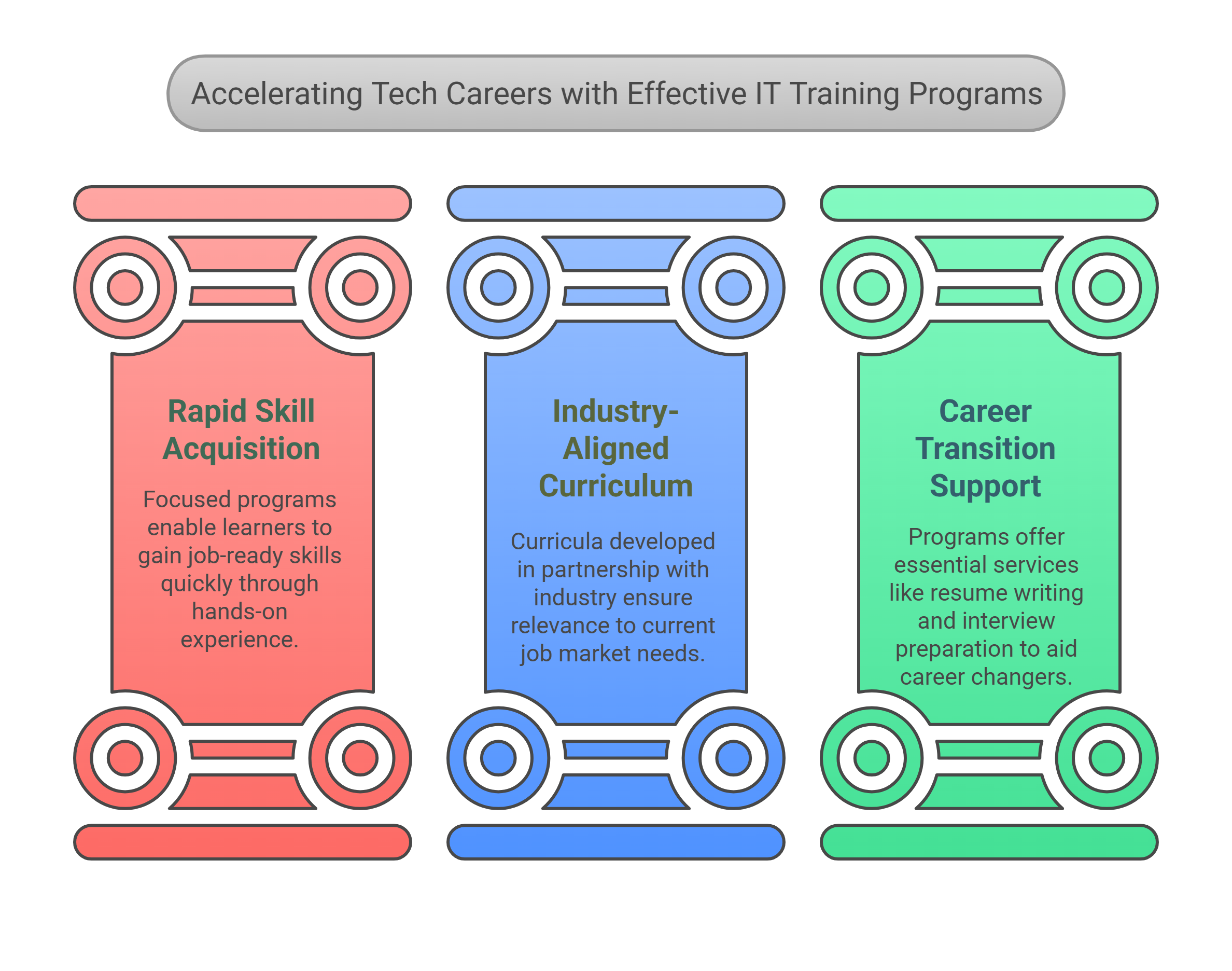
Rapid Skill Acquisition

Unlike traditional four-year degrees, focused IT training programs can equip learners with job-ready skills in months rather than years. These programs emphasize practical, hands-on learning that directly translates to workplace requirements.

Industry-Aligned Curriculum

Quality IT training programs work closely with industry partners to ensure their curriculum matches real-world needs. This alignment means graduates possess the exact skills employers are seeking, from cloud computing to cybersecurity.

Career Transition Support

For career changers or those looking to update their skills, IT training programs often provide crucial support services like resume writing, interview preparation, and job placement assistance.
IT Training Programs

Types of Effective Training Solutions

The landscape of IT training has evolved to meet diverse learning needs:

Bootcamps

Intensive, short-term programs that focus on specific tech stacks or roles, bootcamps have gained recognition for their ability to produce job-ready graduates quickly. They're particularly effective for career changers who need to acquire new skills rapidly. Many popular bootcamps run 5 days and advanced certifications may run for 2 weeks.

Corporate Training Programs

Many companies have developed in-house training initiatives to upskill their existing workforce. These programs help organizations address their specific skills gaps while providing career growth opportunities for employees.

Online Learning Platforms

Flexible, self-paced online courses allow learners to acquire new skills while maintaining their current responsibilities. Platforms often offer certification preparation and practical projects that demonstrate competency to potential employers.


Adult students collaborating on a project in a computer lab.

Making Training Programs Work

For IT training programs to effectively bridge the skills gap, several key elements must be present:

Practical Application

Theory alone isn't enough. Successful programs incorporate real-world projects, internships, or apprenticeships that allow learners to apply their skills in practical settings.

Ongoing Assessment

Regular evaluation of both learner progress and program effectiveness ensures training remains aligned with industry needs and produces qualified candidates.

Industry Partnerships

Strong connections between training providers and employers create direct pathways to employment and ensure curriculum relevance.

The Road Ahead

As technology continues to evolve at an unprecedented pace, the importance of effective IT training programs will only grow. Organizations that invest in training and development today are better positioned to address future skills gaps and maintain competitive advantage.

To truly bridge the skills gap, stakeholders across the ecosystem must work together:

  •  Employers need to clearly communicate their skills requirements and support training initiatives

  • Training providers must stay current with industry trends and maintain high standards of instruction

  •  Learners must commit to continuous learning and professional development

  •  Policymakers should support and incentivize workforce development programs

Team collaborating on coding in a futuristic office with sleek technology

Final Words

The technology skills gap represents both a challenge and an opportunity. While the mismatch between available talent and needed skills poses significant challenges for organizations, it also creates opportunities for individuals willing to invest in their professional development. Through well-designed IT training programs, we can build bridges between talented individuals and the growing number of technology careers awaiting them.

By focusing on practical skills, maintaining industry alignment, and providing comprehensive support services, IT training programs can play a crucial role in addressing the skills gap and preparing workers for success in the digital economy.


Frequently Asked Questions (FAQ) about IT Training

Frequently Asked Questions About IT Training Programs

How long does it typically take to complete an IT training program?

The duration varies significantly based on the program type and your learning goals. Bootcamps are the fastest and typically run 1-2 weeks per certification full-time or 4-8 weeks part-time. With a bootcamp, you must be ready to eat, sleep, train, lab and review long hours every day. Certificate programs might also take 3-6 months, while comprehensive career transition programs could take up to a year. Self-paced online courses offer the most flexibility, allowing you to learn on your own schedule. It all depends on your preference and learning style.

How much do IT training programs cost?

Costs range widely from free online courses to premium bootcamps costing $15,000 or more. Many programs offer flexible payment options, including:

  • ·      Income Share Agreements (ISAs) where you pay after securing a job

  • ·      Payment plans with monthly installments

  • ·      Scholarships for underrepresented groups

  • ·      Employer tuition reimbursement programs

Do I need prior technical experience to start an IT training program?

Most entry-level programs don't require previous technical experience. However, you should be comfortable using computers and have strong problem-solving skills. Many programs offer preparatory courses to help beginners build foundational knowledge before starting the main curriculum.

Which IT skills are most in-demand right now?

·      Current high-demand skills include:

  • ·      Cloud computing (AWS, Azure, Google Cloud)

  • ·      Cybersecurity

  • ·      Data analytics and data science

  • ·      Full-stack web development

  • ·      DevOps

  • ·      Artificial Intelligence and Machine Learning

    However, the specific skills you should focus on depend on your career goals and local job market demands.

How do I choose the right IT training program?

Consider these factors when selecting a program:

  • ·      Learning format (in-person, online, hybrid)

  • ·      Program reputation and outcomes data

  • ·      Job placement rates and career support services

  • ·      Cost and available financing options

  • ·      Time commitment required

  • ·      Curriculum alignment with your career goals

  • ·      Industry partnerships and networking opportunities

Will an IT training program guarantee me a job?

While no program can guarantee employment, many reputable programs have high job placement rates. You can look for programs that:

  • ·      Share verified employment outcomes

  • ·      Offer career services and job search support

  • ·      Have strong employer partnerships

  • ·      Provide networking opportunities

  • ·      Help build your portfolio of practical projects

Can I complete an IT training program while working full-time?

Yes, many programs offer flexible options for working professionals:

  • ·      Part-time schedules

  • ·      Evening and weekend classes

  • ·      Self-paced online learning

  • ·      Hybrid formats combining online and in-person sessions Choose a format that realistically fits your schedule and learning style.

How do employers view IT training program certificates versus traditional degrees?

Many employers recognize alternative credentials, especially from respected training program or a well known certification. What matters most is your ability to demonstrate practical skills through:

·      Portfolio projects

·      Technical assessments

·      Industry certifications

·      Real-world problem-solving abilities Some employers may still prefer degrees for certain roles, but hands-on experience and proven skills often matter more than traditional credentials.

How can I ensure the training program I choose is legitimate?

Research these aspects:

  • ·      Verified student reviews and testimonials

  • ·      Employment outcome data

  • ·      Accreditation or industry recognition

  • ·      Partnerships with known companies

  • ·      Transparency about costs and requirements

  • ·      Quality of curriculum and instructors

  • ·      Track record of successful graduates

What support should I expect from an IT training program?

Quality programs typically offer:

  • ·      Technical mentorship

  • ·      Career coaching

  • ·      Resume and portfolio review

  • ·      Interview preparation

  • ·      Job search guidance

  • ·      Networking events

  • ·      Alumni community access

  • ·      Ongoing learning resources

Remember that your success in any program largely depends on your commitment and effort. Choose a program that aligns with your goals and learning style, and be prepared to invest significant time and energy in your learning journey.

Mike G.

IT Certification Jump

Beginner

0 Comments

Related Posts All Posts

Do IT Certifications Matter Without Experience? Here’s the Truth

Have you ever wondered if stacking IT certifications truly gives you an edge—or if employers still value hard-earned experience more? In today’s hyper-competitive tech job market, the debate around certification vs experience is louder than ever.Whether you’re just starting out or hoping to level up, knowing what hiring managers really want could be the key to unlocking career growth and landing your ideal job role. Let’s challenge what you’ve been told and uncover the truth.Are IT Certifications Worth It Without Experience? Challenging What You’ve Been ToldThe tech world can seem obsessed with certified professionals—every job posting or LinkedIn profile boasting a string of credentials. But is a certification enough to get your foot in the door if you lack actual work experience? Let’s break down the realities behind the emphasis on certifications, especially for early or mid-career tech pros.Certifications and experience act as powerful calling cards, especially for entry-level candidates. They promise hiring managers a certain foundational skill set backed by a reputable issuing organization. However, experienced employers know there’s a world of difference between passing a test and applying knowledge on the job. Certifications alone rarely tick all the boxes for job requirements , particularly for roles that demand hands-on problem-solving or workplace acumen.If you’re unsure whether certifications alone are enough to launch your career, understanding how employers evaluate certifications and experience is crucial. Let’s dig deeper into the trade-offs—and why relying on just one side of the equation can limit your potential for career advancement.For those considering which certifications can truly make a difference at the start of your IT journey, it’s helpful to explore which credentials are most valued by employers. You might find this overview of top entry-level IT certifications that actually get you hired especially useful as you weigh your options.What You'll Gain by Understanding Certification vs ExperienceDiscover how employers weigh certifications and practical experienceUncover which matters more for early and mid-career tech prosUnderstand how to balance your professional development for career growthCertification vs Experience: Defining the Debate in IT CareersThe ongoing debate of certification vs experience shapes hiring and promotion decisions in tech. On one side, certifications reflect structured learning and mastery of technical skills through training courses and exams. These credentials—sometimes even more than a college degree—show potential employers your dedication to your chosen field and your willingness to learn.On the other side, experience means practical, on-the-job lessons you gain through project delivery, teamwork, and day-to-day problem solving. It’s the evidence that you can translate textbook knowledge into real solutions—an area where experienced professionals stand out. Most hiring teams consider experience the clearest proof that you can adapt to fast-evolving job requirements in the tech world.What is the difference between certification and experience?Certification is often a badge earned by passing an exam or a series of training courses from a recognized issuing organization. It’s measured, objective, and easy for hiring teams to verify during the hiring process. Experience , by contrast, is tied directly to the work you’ve delivered in a real-world setting. That means exposure to the unexpected, developing a deep skill set beyond the theory, and gaining references from a previous employer to verify your capabilities.Crucially, both sides offer unique advantages. Certifications provide a quick proof of certain technical skills—even if you lack work experience—while experience confirms you can perform in a specific job role. Understanding the differences between certifications and experience is vital for shaping an optimal path for career growth.How Employers Weigh Certifications and Experience for Career GrowthThe approach to certification vs experience may vary depending on the employer’s needs, the tech sector, and the specific job. Entry-level roles often lean heavily on certifications because candidates may not have much practical exposure. Here, foundational credentials can open doors that might remain closed for those with only raw passion or informal learning.For mid-level and senior roles, however, hiring managers are laser-focused on proven work experience. They seek evidence that you can handle increasing responsibilities, lead teams, or drive significant results. Having both certifications and experience helps candidates stand out for promotions and strategic leadership opportunities.Certifications and Experience: Hiring Patterns in TechHiring FocusImportance to EmployersImpact on Career GrowthEntry-LevelCertifications Weighted HeavilyBoosts Initial Job ProspectsMid-LevelExperience and CertificationsUnderpins Promotions and PaySenior-LevelExperience DominatesDetermines Leadership RolesDoes Certification Count as Experience in IT Hiring?There’s a common misconception that simply holding a certification “counts” as equivalent to hands-on work experience. In reality, while certifications remain important, most hiring teams view them as evidence of theoretical or academic achievement—not as true substitutes for substantial, real-world learning.Certifications can show you’ve mastered concepts and can be a prerequisite to moving through an interview process , but they rarely check the same box as actually performing a specific job in the field.That said, certain certifications now embed practical labs or scenario-based testing—an attempt to bridge this gap. Even so, employers still weigh your ability to apply that knowledge through work experience above all. Certifications and experience both help you get noticed, but your experience is what ultimately convinces interviewers you can thrive in the role."Certifications may open the door, but experience walks you through." – Tech Industry LeaderCertifications and Experience: Which Is Better for Career Advancement?The question often isn’t which is better— certifications or experience —but rather how to use both strategically for career advancement. For those starting out, certifications in highly sought areas (cloud computing, networking, cybersecurity) can open doors that otherwise require years of work experience to unlock. You demonstrate a baseline of knowledge aligned with the latest technological standards.For those eyeing a mid-level or senior job role , experience takes top priority. It proves your resilience and ability to adapt in a dynamic environment. The best approach is to treat certifications as foundation stones—stepping stones toward greater responsibility, not as replacements for experience.Which is better, experience or qualification?Experts widely agree that in the world of IT and tech , neither certifications nor experience alone can carry your career forever. Qualifications can help you land that vital first or second role, but robust experience and a diverse skill set will propel you forward, especially when leadership or specialized expertise is required. Ultimately, the relative importance of each shifts as you advance in your chosen field.IT Career Growth: Balancing Certifications and ExperienceStriking the right balance between certifications and experience isn’t always clear-cut. For early-career professionals , obtaining respected foundational certifications—such as CompTIA A+, CCNA, or AWS Certified Solutions Architect—can signal instant value to employers. However, supplementing those certs with hands-on projects, internships, or even volunteer opportunities is what builds a comprehensive skill set recognized in any hiring process.As technology rapidly evolves, continuous learning is non-negotiable. Employers expect candidates to actively update skills through both training courses and real-world problem solving. Staying relevant is the only way to outpace the competition and consistently find new career growth opportunities as an experienced IT professional.Combine foundational certifications with hands-on projects to stand outLeverage internships and volunteer work to complement your technical credentialsContinuously update skills to stay relevant in the tech industryWhat's the Difference Between Qualifications and Experience?Qualifications , such as certifications, diplomas, or degrees, reflect your formal accomplishments through structured learning. Employers value these because they signify a standard of excellence verified by an external body. However, having only qualifications can sometimes signal a lack of the agility needed in ever-changing tech environments.Experience demonstrates how you perform when facing real-world challenges, from technical troubleshooting to managing teams and delivering against tight deadlines. While qualifications secure attention during the hiring process , experience sustains your momentum and builds leadership credibility. For holistic career advancement, both are essential—but rely too heavily on either, and you may encounter barriers to growth.Overcoming Common Misconceptions: Certifications and Experience in TechToo often, job seekers assume that certifications and experience alone will guarantee employment. Yet surveys of leading hiring teams show a clear pattern: certifications get you noticed, but without supporting evidence of real work experience or applicable technical skills , offers remain rare. Employers crave candidates who balance the rigor of structured learning with a demonstrable record of impact.The best path to career growth in tech is a balanced one—supplementing certifications and experience by actively accumulating hands-on skills, and constantly updating both as technologies evolve.Myth vs Reality: Do Certifications Guarantee a Job Without Experience?Myth: Certifications alone guarantee employment Reality: Most tech recruiters seek a blend of practical and theoretical knowledgeAnalysis: How Hiring Managers View Certifications and ExperienceIn recent video interviews with hiring managers, a common theme emerged. Most believe certifications validate determination and a desire to learn, which is helpful in the initial screening. Yet, when making final hiring decisions, these leaders rely far more on descriptions of previous employer projects, technical challenges overcome, and a clear fit for the specific job role. Balanced candidates—those who pair certifications with a track record of real results—are considered top talent and move fastest through the hiring process.Ultimately, while certifications may help "open doors," it’s your portfolio of experience and impact that delivers job offers and consistent career growth.Top Certifications That Can Accelerate Career Growth Without Traditional ExperienceCompTIA A+Cisco Certified Network Associate (CCNA)AWS Certified Solutions ArchitectMicrosoft Certified: Azure FundamentalsPeople Also AskWhat is the difference between certification and experience?Certification is a formal recognition that you have mastered a specific set of skills or knowledge—usually awarded after passing standardized exams or training courses. Experience is the hands-on practice you gain by actively working in the industry, solving real problems, navigating workplace challenges, and exceeding job expectations. Both play key roles in shaping a successful IT career.Does certification count as experience?While certifications demonstrate technical competence and knowledge, most employers consider them separate from actual work experience. Certifications boost your profile in job applications, but they do not replace the impact and credibility that come from performing a job in the field. Experience is earned through practice, not just study.Which is better, experience or qualification?It depends on where you are in your career growth. For entry-level candidates, a well-known certification can help you qualify for interviews and meet job requirements. In contrast, as you progress to mid-level or leadership roles, proven work experience becomes significantly more important in advancing your career.What's the difference between qualifications and experience?Qualifications—such as certifications, degrees, or diplomas—are formal markers of completed structured learning and skill assessments. Experience demonstrates your ability to thrive in real work environments, adapt to changing requirements, and contribute effectively to a team or organization. Combining both creates the strongest foundation for long-term career advancement.Industry Leaders on Certification vs Experience"A certification may get your resume past the first filter, but real progress demands proven results." – CTO, Global Tech Solutions"We hire for attitude and aptitude, but promote based on experience." – Senior HR Manager, Fortune 500 CompanyFrequently Asked Questions About Career Growth Through Certifications and ExperienceHow do I choose between pursuing certifications and gaining experience? Match your approach with your immediate goals: if you’re entering a new technical field, begin with foundational certifications to prove readiness for interviews. Simultaneously, seek internships or volunteer roles that provide hands-on experience.Can certifications help if I’m making a career switch? Absolutely. Certifications demonstrate commitment and knowledge, making you a credible candidate for entry-level opportunities in your new field—even if your past experience lies elsewhere.Will experience outweigh certifications as I advance? Yes. As you progress, employers prioritize leadership, adaptability, and past impact. These are proven through accumulated work experience, complemented by up-to-date certifications.Crafting Your Path: Blending Certification and Experience for Ultimate Career GrowthStart with relevant, respected certifications in your chosen IT fieldSeek internships or real-world projects to gain hands-on experienceContinuously update your certifications as technologies evolveDocument achievements and quantify your impact in each roleFinal Thoughts: Making Certification vs Experience Work for YouIt doesn’t have to be certification versus experience — it’s how you use both that counts. Let your certifications validate your knowledge while your hands-on work proves you can deliver in the real world. Treat them as stepping stones you can alternate between: study, apply, reflect, repeat, and you’ll supercharge your growth faster than choosing one path alone. Pick certifications that map to your goals, then turn every new concept into a small project, a portfolio entry, or an on-the-job win. Do that consistently and you’ll be unstoppable in the tech industry — so choose one cert to pursue and one project to build this week, and get moving.Ready to Take Charge of Your Career Growth?Whether you’re new to IT or looking to break through the next ceiling, don’t choose between certification vs experience —embrace both. Start your journey today and craft a path unique to your goals!If you’re eager to go beyond the basics and truly master the art of IT career development, consider exploring advanced strategies that blend learning with real-world application. Our comprehensive resource on IT certification success beyond the books dives deeper into actionable steps, mindset shifts, and proven techniques for long-term growth.By expanding your approach, you’ll not only stand out in a crowded field but also future-proof your skills as technology evolves. Take the next step and unlock your full potential in the tech industry.When evaluating the importance of certifications versus experience in IT careers, it’s essential to consider insights from industry experts. The article “Ask the IT Career Doctor: Certifications vs. Experience” on Dice.com emphasizes that while certifications can indicate knowledge in a given area, they don’t demonstrate the ability to apply that knowledge in the workplace. Employers often prioritize candidates with a proven track record of real-world contributions. Similarly, the piece “IT Certifications vs Experience vs Degree | What’s Most Important” from ITCareerFinder.com highlights that while certifications are valuable, real-world experience remains the best indicator of how well you will perform on a new job. Employers look to your actual experience to grasp how well you are able to execute in a work setting.If you’re serious about advancing in the IT field, these resources provide valuable perspectives on balancing certifications and practical experience to enhance your career prospects. ITCertificationJump.com

Is This the Easiest Programming Language to Learn? Find Out!

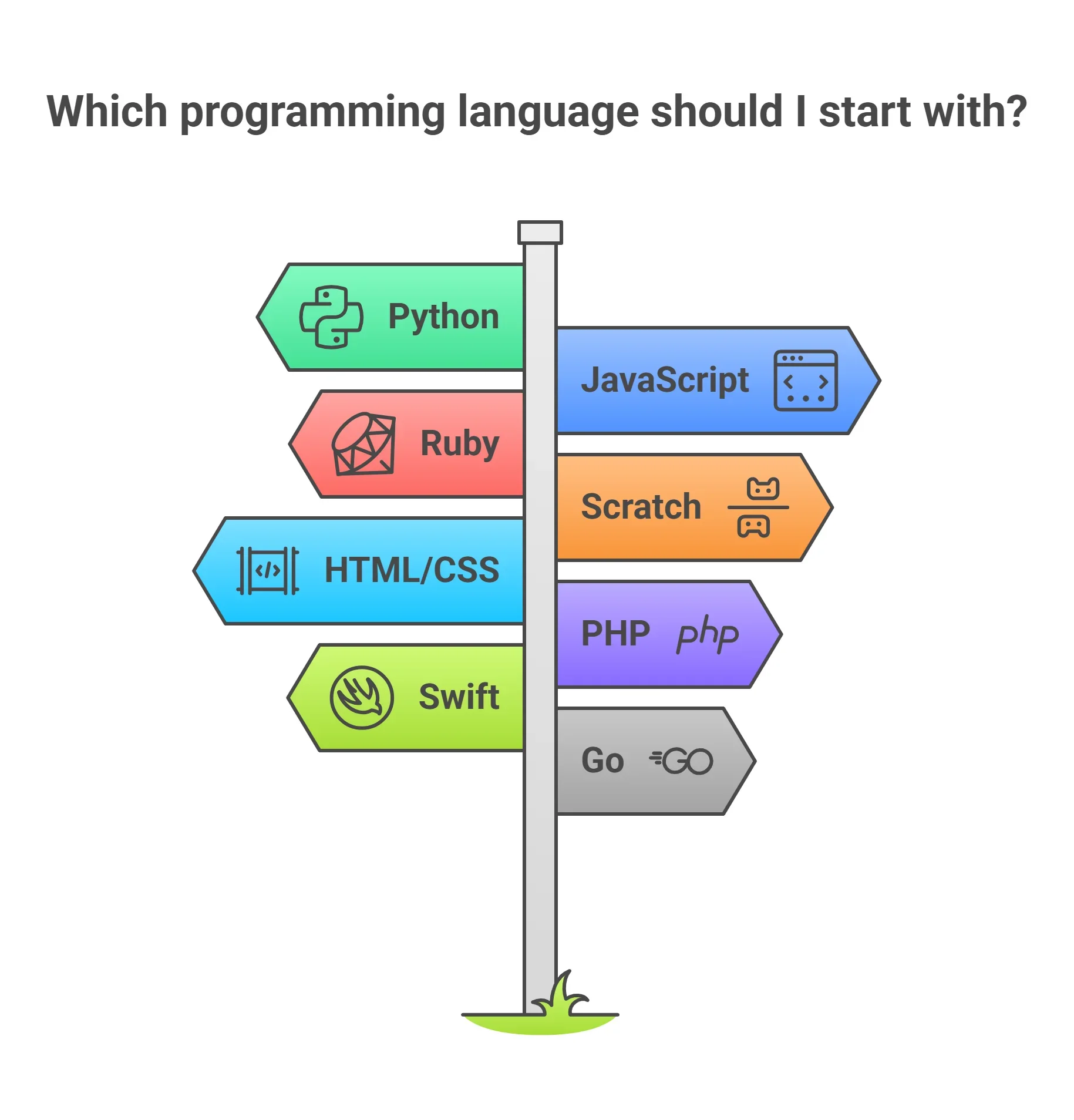
Wondering which programming language beginners find easiest? Discover the language that makes coding simple and fun, and see how it can jumpstart your tech journey with less frustration and more success. Ready to unlock your coding potential effortlessly?Discover Why the Easiest Programming Language to Learn Matters for Your Coding JourneyChoosing the easiest programming language to learn is a pivotal step for any aspiring coder. The path you start on can impact your confidence, pace, and overall success as you learn programming. A beginner-friendly, easy to learn programming language not only reduces the risk of early discouragement but sets a positive tone for your ongoing learning process. Starting with the right language means spending less time puzzled by syntax and more time mastering essential programming concepts and solving real problems.For many, the journey into software dev, web development, or data science begins with a language that’s approachable and well-supported. The simplest programming language provides a smoother transition from thinking about logic to actually building things.Strong community support, abundant learning resources, and clear error messages make learning less intimidating. Ultimately, your starting point shouldn't hold you back; it should invite you in, keep you motivated, and help you build skills that are in high demand on the job market.How Choosing the Easiest Programming Language Impacts BeginnersFor beginners, selecting an easy to learn programming language can make the difference between struggling to understand basic concepts and confidently creating your first working programs. Intuitive languages minimize confusion—a clean syntax with fewer special symbols (such as curly braces) means less time hunting for missed punctuation and more time seeing your code run as expected. With the right language, you can prototype creative ideas, build web pages, and even dabble in machine learning without years of prior experience.Beyond ease of use, the plainspoken programming language is often supported by plenty of tutorials, online courses, and beginner-focused communities. This aspect is crucial since the initial learning process is often filled with questions and small errors, especially when you get your first error messages.Having a supportive environment makes sense for new learners, turning what might be roadblocks into learning opportunities. In many cases, the fastest way to build foundational skills is simply to dive into a language designed for accessibility.As you explore which language to start with, it's also helpful to consider how your learning environment and available tools can shape your experience. For those interested in hands-on experimentation and interactive learning, platforms like Jupyter Notebooks and Azure ML Studio offer beginner-friendly ways to practice coding and data science concepts. You can learn more about these practical tools and how they support new programmers in this field guide to Jupyter Notebooks, Azure ML Studio & Friends.What You'll LearnKey traits of the easiest programming language for beginnersComparison of leading programming languages for ease of learningReal-world applications made possible by easy to learn programming optionsExpert insights on selecting the right beginner programming languageStrategies and resources to help you start learning quicklyWhat Defines the Easiest Programming Language to Learn?Identifying the simplest programming language to learn involves more than counting how many people use a specific language. True beginner-friendliness is built into the language’s design. The ideal starting point features a clean syntax—meaning the instructions you type mimic everyday language as closely as possible and avoid unnecessary symbols or complicated structure. But ease of learning also comes from robust support, accessible documentation, and a forgiving approach to errors.It’s not just about mastering the commands—a language’s ecosystem also matters. Popular languages with large communities will provide more abundant and diverse learning resources, making it easier to find help when you get stuck. For an aspiring software developer or a future data scientist, choosing a language with real-world relevancy and supportive infrastructure is key in reaching your goals quicker and with less frustration.Core Features of an Easy to Learn Programming LanguageClear and concise syntaxComprehensive learning resourcesUser-friendly error messagesHigh demand in the job market"Many beginners credit clear syntax and robust learning resources as the most crucial aspects when starting their programming journey." – Dr. Karen Wu, Software Engineering ProfessorComparing the Easiest Programming Languages for BeginnersTable: Side-by-Side Comparison of Easiest Programming LanguagesLanguageSyntax ClarityError MessagesPopular Use CasesCommunity SupportLearning ResourcesPythonVery high (English-like, minimal punctuation)User-friendly, clearWeb development, data science, automation, scriptingExtensive, globalExtensive tutorials, docs, coursesJavaScriptHigh (familiar to many, some quirks)Descriptive, browser-basedBuilding web apps, dynamic web pagesVery large, activeLots of free online contentRubyVery high (readable, minimal symbols)Helpful, beginner-orientedWeb backends, scriptingWelcoming, responsiveComprehensive guides, booksScratchN/A (block-based visual coding)Visual hints, instant feedbackGame creation, teaching kidsFriendly to young learnersLesson plans, videosSwiftHigh (especially with Swift Playgrounds)Modern, clearMobile app, iOS, Apple devicesRapidly growingOfficial guides, interactive toolsWhy Python Is Often Named the Easiest Programming Language to LearnSimple, English-like syntaxWidely available tutorials and guidesVersatility for web, app, and data projectsActive global community"Python’s readability and straightforward approach make it a favorite for educators and first-time programmers alike." – David Kim, Senior Software DeveloperPython stands out among easy to learn programming languages due to its approachable design and active ecosystem. Unlike some popular languages that require understanding curly braces or complex punctuation, Python’s clean syntax allows you to focus on problem-solving, not arcane grammar.Its strong presence in web development, data science, and machine learning means your beginner projects can lead directly into high-demand fields without needing to relearn too much.The overwhelming availability of learning resources—ranging from interactive tutorials to free bootcamps—ensures even absolute beginners have supportive pathways to success. Python’s error messages are typically clear and designed to help novices pinpoint and correct simple mistakes.For many, it just makes sense: starting with a language that stays relevant as you grow your skills streamlines the learning process and maximizes your future job opportunities in tech.Other Programming Languages Often Considered 'Easy to Learn'JavaScript: Best for building web applicationsRuby: Praised for readable syntax and active communityScratch: Visual learning for absolute beginnersSwift: User-friendly for building iOS and mobile appsWhile Python is often called the most straightforward programming language to learn, other languages offer beginner-friendly experiences depending on your interests. JavaScript unlocks the ability to build web apps that work directly in the web browser.Ruby’s clean syntax is beginner-friendly and is especially renowned for web backends, while Scratch takes a revolutionary approach with its block-based, visual interface, focusing on the absolute basics of logic and sequencing—perfect for younger learners or those who want a gentle introduction.Swift is a great entry point if your aim is mobile app development, especially on Apple platforms. Each of these languages provides comprehensive learning resources to help beginners build web, mobile, or simple projects.Real-World Applications and Demand: Building With the Easiest Programming LanguageFrom Web Development to Mobile Apps: What Can You Create?Build web platforms with JavaScript or PythonCreate mobile app prototypes using Swift or PythonDevelop automation scripts for daily tasksExplore data analysis projects"Starting with an easy to learn language lets learners see quick results—be it a website, app, or a data project—which keeps motivation high." – Jessica Lee, Coding Bootcamp InstructorWith the simplest programming language to learn at your fingertips, you’ll be surprised how quickly you can move from basics to real-world projects. Whether you want to build web pages or entire web apps, try your hand at mobile app development, or automate daily tasks, the journey is far more manageable with the right starting point. For many, immediate results provide the encouragement needed to keep learning and to eventually contribute to both personal and professional projects.The practical skills gained serve as stepping stones to more advanced fields like data analysis, machine learning, or even building full-fledged web backends. The accessibility, versatility, and fast feedback loop of beginner-friendly languages means that you can enjoy building things from day one, while steadily building your confidence and experience.High Demand and Job Opportunities for Beginner ProgrammersCommon entry-level roles requiring easy to learn programming languagesGrowing industries in tech, data science, and software engineeringThe skills you gain by mastering an easy to learn programming language are sought after in a rapidly expanding digital job market. Roles such as junior software developer, QA tester, data analyst, and website content specialist all value practical coding ability—especially in languages widely recognized for their beginner-friendliness. Tech organizations recognize that programmers who have learned sought-after languages like Python or JavaScript can quickly adapt and grow into more complex roles.As industries in web development, data science, and software engineering continue to grow, so does the need for talented developers with strong foundations. Beginning with the forthright programming language to learn is not just about simplicity; it’s a direct pathway into industries that are dynamic, lucrative, and future-proof."Employers are looking for solid foundational skills—starting with a beginner-friendly language puts you on the fast track to a coding career." – Priya Shah, Technical Recruiter, CodeBridge TalentCommon Challenges With Easy to Learn Programming LanguagesTypical Error Messages and How to Overcome ThemSyntax errors and simple misstepsRead and interpret error messagesWhere to get quick help: forums and documentationEven the simplest programming language to learn will present stumbling blocks—most commonly, error messages that can seem confusing at first. Syntax errors, such as a missing parenthesis or misspelled word, are among the most frequent issues beginners encounter. The good news? Readable error messages and comprehensive online help make overcoming these obstacles less intimidating.If you hit a snag, don’t get discouraged. Online platforms like Stack Overflow, the official documentation, and beginner coding forums are full of people ready to help. Learning how to interpret error messages is a crucial part of the process, and with consistent practice, you’ll find that troubleshooting becomes second nature. Think of every error as a learning opportunity—a stepping stone toward mastery.Accessing Reliable Learning Resources for the Simplest Programming LanguageOnline tutorials and video seriesInteractive coding platformsCourseware from universities and bootcampsAccess to quality learning resources can define your experience as a beginner in programming languages. The best programming language for you is often the one with the richest ecosystem of tutorials, interactive labs, and community-created guides. Utilizing platforms like Codecademy, free online video classes, or university-backed courseware gives you structured, clear pathways to progress.Many beginners also benefit from interactive coding environments where you can write, test, and debug your code instantly. These platforms provide instant feedback and allow you to learn by doing, which is proven effective for retaining new concepts. Don’t hesitate to explore university or bootcamp offerings if you prefer a guided experience—they’re often built around the easiest programming language to learn, ensuring your entry is smooth and rewarding.Expert Tips: How to Make the Most of Learning the Simplest Programming LanguageStrategies for Rapid ProgressCode daily, even in small incrementsJoin beginner-friendly coding communitiesPractice with mini projectsRapid progress in programming relies on consistent practice and exposure to real code. Dedicate daily time—even brief sessions—to coding: this habit turns abstract concepts into practical skills through repetition and experimentation. Joining beginner-friendly communities (such as online forums, Discord groups, or local meetups) surrounds you with others on a similar journey, providing encouragement and accountability.Focus on mini projects that interest you, whether it’s a simple web page, a data analysis script, or a game. Projects not only reinforce programming concepts but also produce tangible results you can show off or share.Remember, building things is central to learning—real-world application cements what tutorials teach. By combining these strategies with a programming language designed for accessibility, you'll overcome obstacles and reach milestones quickly.Leveraging Community Support and Real-World PracticeCollaborate on open-source projectsAttend code-alongs and workshopsShare your progress for feedbackCommunity support amplifies your learning experience. Participating in open-source projects—or even just browsing their code—offers exposure to real-world practices and lets you contribute meaningfully as you learn. Code-alongs, hackathons, and hands-on workshops are perfect opportunities to build practical skills, meet mentors, and get your questions answered in real time.Don’t be shy about sharing your progress, even if your project feels small—public feedback helps you grow and connects you to like-minded coders who can offer tips or encouragement. Remember, everyone starts somewhere, and the most important step is the one you take today toward mastering the easiest programming language to learn.People Also AskIs C++ harder than Python?Answer: For most beginners, C++ is considered more challenging due to complex syntax and stricter rules, while Python is widely regarded as an easy-going programming language to learn because of its readability and simplicity.Is 25 too old to start coding?Answer: Absolutely not. There is no age limit for learning the simplest programming language or starting a career in programming. Many successful developers began coding later in life.What coding did Elon Musk learn?Answer: Elon Musk started coding with BASIC, an early and easy to learn programming language designed for beginners, before moving to more advanced languages over time.Is coding harder than math?Answer: Coding and math are different skill sets. The most comfortable programming language to learn often requires logical thinking more than advanced mathematics, especially for beginners.Frequently Asked Questions (FAQs) About the Easiest Programming Language to LearnWhich programming language is best for absolute beginners?Python is often the top recommendation for those just beginning their programming journey. Its straightforward syntax and robust ecosystem of learning resources make it ideal for understanding programming basics, building web pages, and starting with data projects. However, if your main focus is interactive web development, JavaScript is also extremely beginner-friendly.How quickly can I learn the easiest programming language?For most beginners, dedicated daily practice via tutorials and small projects can lead to basic proficiency in the easiest programming language to learn within a few weeks. Consistent effort and seeking help when needed will accelerate your progress. Choosing a language with ample community support and interactive platforms ensures you steadily build essential skills at your own pace.Do I need a technical background to start learning programming?No prior technical experience is required to begin with the easiest programming language to learn. Modern languages like Python are specifically designed to be approachable for non-technical learners, and most learning resources assume you’re starting from zero. The most important asset is curiosity and the willingness to experiment and learn from small mistakes.Key Takeaways for Choosing the Easiest Programming Language to LearnPython is often considered the top choice thanks to its readability and versatility.Choose a language aligned with your goals—web, mobile app, or data science.Leverage community support and abundant learning resources for success.Beginner-friendly languages minimize frustration and maximize results.Ready to Start With the Easiest Programming Language? Your Next StepsFor more great IT certification training content, visit: ITCertificationJump.comConclusionThe easiest programming language to learn is your gateway to building confidence and unlocking future tech opportunities—choose wisely, persist, and your coding journey will be rewarding and empowering.As you take your first steps into programming, remember that choosing an accessible language is just the beginning of your tech journey. If you’re still wondering whether an IT career is the right fit for you, or want to explore the broader landscape of opportunities and personal growth in technology, consider reading this comprehensive guide on discovering if an IT career is for you.It offers practical advice, self-assessment tips, and insights to help you align your learning path with your long-term goals. Exploring these perspectives can empower you to make informed decisions, build confidence, and unlock new possibilities as you grow from beginner to tech professional.SourcesfreeCodeCamp – https://www.freecodecamp.org/news/what-are-the-easiest-programming-languages-to-learn/Real Python – https://realpython.com/python-beginner-tips/Codecademy – https://www.codecademy.com/resources/blog/best-programming-languages-to-learn/When starting your programming journey, selecting a language that aligns with your goals and offers a gentle learning curve is crucial. For those interested in web development, JavaScript is indispensable, enabling the creation of interactive websites and applications. Its widespread use and immediate visual feedback make it a practical choice for beginners. (forbes.com)Alternatively, if you’re aiming to develop applications within the Apple ecosystem, Swift provides a modern and readable syntax, making it accessible for newcomers. Apple’s support through tools like Swift Playgrounds further facilitates the learning process. (softensity.com)Exploring these resources will help you make an informed decision and set a solid foundation for your programming endeavors. ITCertificationJump.com

The Digital Filing Cabinet: Database Concepts for Beginners Explained Using Everyday Logic

Learning database concepts helps you understand how to organize, store, and retrieve information efficiently to prevent data chaos. Much like sorting groceries or pairing socks in a drawer, database management applies everyday logic to structure data so that it remains accurate, complete, and easy to access exactly when you need it.Why Learn Database Concepts for Beginners? (Opening with Everyday Logic)Ever felt overwhelmed by complex tech jargon? You're not alone. This guide explains how database concepts for beginners can be understood using practical, everyday logic. Say goodbye to confusion!What You'll Learn About Database Concepts for Beginners ExplainedCore principles of relational database and database managementHow a database management system worksEveryday metaphors to understand database structures and data organizationPractical uses for relational data and query languageReal-world applications and pathways to IT certificationWhat Is a Database? Understanding the Digital Filing CabinetBreaking Down Database Concepts for Beginners ExplainedWhat is a database?How does everyday life mimic a database system?Database management analogies (think sock drawers, kitchen cabinets, and more)A database is an organized collection of data—think of it as your digital filing cabinet for information. Instead of stuffing papers into drawers at random, a database stores data smartly, illuminating the chaos that often plagues our desks (and sometimes, our minds!). Everyday life is sprinkled with subtle nods to database systems.Consider your kitchen cabinet: plates, cups, and bowls have their own spots. This organization makes finding your favorite mug at 7:00 a. m. a breeze. Similarly, a database system crafts order out of digital data: files have their place, records are labeled, and everything can be located quickly.Diving deeper into database concepts for beginners explained, imagine your sock drawer. If socks end up everywhere but in pairs, morning routines get hectic fast. A good database management strategy means every sock (piece of information) is snug in its place—no chaos, no single mismatched sock left behind.Everyday logic, like sorting groceries or organizing folders for schoolwork, is essentially database management in action. It’s about storing information efficiently and keeping track of everything so you can easily access it when needed.Database Management: From Messy Desk to Digital HarmonyThe Role of Database Management in Organizing InformationWhat is database management?Why is database management system crucial for businesses and individuals?The myth of ‘fearless data wranglers’—anyone can organize like a pro!Database management is all about turning digital messes into neat, orderly systems. Imagine a desk buried in papers—finding an important note could take hours (or months, if you’re me). Now, what if every document was perfectly labeled and categorized? Welcome to the power of a database management system (DBMS)—it transforms digital disarray into harmony, just like cleaning a cluttered desk brings instant peace and productivity.From storing contact lists in your phone to tracking millions of inventory items in a global business, a DBMS ensures that data is structured, secure, and accessible in real time. This isn’t just for tech geniuses—even beginners can become so-called ‘data wranglers. ’Mastering fundamental concepts of database management means anyone can manage data efficiently, prevent information bottlenecks, and maintain order as digital information grows exponentially. Businesses thrive on this logic, individuals enjoy less stress, and the whole digital world becomes a little less intimidating.If you're interested in how foundational tech concepts can be made approachable, you might also enjoy this practical guide to understanding your laptop's essential features, which uses everyday language to demystify the technology you use every day."A good database management system is like the ultimate filing setup—everything has its place, and anyone can find what they need at warp speed."Types of Databases: Which Digital Filing Cabinet Fits Your Needs?Overview: types of database vs types of databasesRelational database: The classic organization methodNoSQL: When your collection gets quirkyFlat files, object-oriented, distributed, and moreNavigating types of database systems is like shopping for filing cabinets: there are options for every need, from simple to complex. The relational database—like a set of perfectly aligned drawers—organizes information in tables, each connected with logical relationships. When you want reliability and order, relational databases are the go-to (think SQL databases: structured, consistent, and easy to search).But sometimes, life (and data) gets quirky. Enter NoSQL databases: these are the wild, expandable shelves for unstructured or rapidly changing information—perfect for social media content or big data analytics. There are also flat file databases (simple, like a spreadsheet), object-oriented databases (storing data as objects, great for developers), and distributed databases (info scattered across many locations but acting as one). Each database system serves a unique purpose, from organizing playlists to running global e-commerce empires.Inside the Relational Database: Making Sense of Relational DataHow Relational Database Management WorksRelational database 101: tables, rows, and columnsWhy relational databases love order (but hate missing socks)Relational data and how it prevents chaosLet’s peek inside the relational database—the tried-and-true champion for structured data. Picture a series of well-organized tables: each has rows and columns, like a familiar spreadsheet. A row contains a single record (think: your friend Bob’s details), and a column stores a type of information (like all birthdays). The magic comes when tables are linked—for example, “People” and “Addresses” tied together—making data easily accessible and related, hence the name relational database.Relational databases are obsessed with order; they're designed to keep everything in sync (think: no more missing socks or duplicates that make laundry day a nightmare). When you store data as relational data, you guarantee accuracy, reduce chaos, and make it simple to query or update just what you need. Spreadsheets are fine for grocery lists, but when the large amount of information grows (like customer lists or order histories), a relational database is your best friend for avoiding a data disaster.Comparison of Relational vs Non-Relational DatabasesFeatureRelational DatabaseNon-Relational DatabaseStructureTables with rows & columnsFlexible models (documents, key-value, graph, etc.)Data ConsistencyVery strong (enforces rules)Often eventual (can be more flexible)Query LanguageSQL (Structured Query Language)JavaScript, JSON, proprietary APIsWhen to UseStructured data, clear relationshipsUnstructured or rapidly changing dataExamplesMySQL, PostgreSQL, OracleMongoDB, Cassandra, RedisMeet the Database Management System (DBMS)—Your Digital LibrarianHow a Database Management System Supports Everyday LogicWhat exactly is a database management system?How does a management system work behind the scenes?From Google search to pizza delivery: DBMS powers everyday tasksThink of the database management system (DBMS) as your personal digital librarian. When you ask where a specific book is, the skilled librarian doesn’t just know—it’s instantly fetched, in pristine condition! A DBMS does the same: when you need to store data or search for information, it seamlessly manages, secures, and retrieves everything with ninja-like efficiency.Behind the scenes, a DBMS is orchestrating order. It keeps data structured, controls access, enforces rules, and helps multiple users interact with the data at once—all without any shouting or trampled bookshelves.Everyday activities rely on DBMS magic: Google searches, email inboxes, online food delivery, and even organizing your photo library are possible because the management system is working tirelessly in the background.So whether you’re a casual user or aspiring IT professional, understanding the role of a DBMS is fundamental to mastering database concepts for beginners explained.Structured Query Language (SQL): Talking to Your Digital Filing CabinetStructured Query, Query Language, and Finding the Information You NeedIntroduction to structured query language (SQL) for beginnersQuerying like a pro: 'Find all the socks!' and other requestsWhy query language is your best friend for information retrievalWelcome to the secret language of databases: Structured Query Language (SQL). Imagine asking your filing cabinet to “Find all the blue socks. ” With SQL, that's not just possible—it’s instant. A query language lets you communicate directly with your database to retrieve, add, update, or delete records as needed.Learning basic SQL is like mastering the ultimate set of search-and-find commands. With just a few simple instructions, you can pull up that lost playlist, sort your favorite recipes, or extract contact information from years of digital clutter.SQL works behind the scenes in almost every app or website you’ve used that organizes information. Even if you’re not ready to program, understanding the logic of queries—think asking What do I need? Where is it stored?—is an essential part of database concepts for beginners explained."SQL is the language of databases—if databases are filing cabinets, SQL lets you ask: ‘Hey, where’s my stuff?’ and actually get an answer!"Everyday Database System Examples: Relatable ScenariosFavorite databases in common useDatabases in apps, social media, and e-commerceRelational databases keeping your playlists and contacts organizedIf you think database systems sound too “techy” for daily life, think again! Your phone’s contact list, streaming playlists, social media feeds, and online shopping carts are all powered by databases—often complex ones working quietly behind the curtain. Every time you browse a clothing store online, your choices are being matched to products and recommendations living in a relational database.Apps like Spotify or iTunes use relational data to keep playlists (rows and columns galore!) organized. Social platforms use database management to ensure posts, friendships, and likes show up in the right feeds. Even your grocery loyalty card relies on a real time database to update points and coupons the next time you shop.Learning these database concepts for beginners explained not only demystifies the tech but also shows how they make life smoother, more organized, and way more fun.Relational Data and Real-World ApplicationsHow Businesses Leverage Relational Database ManagementDatabases in banking, healthcare, and retailHow database systems streamline operationsReal-life database management disasters (and how to avoid them)Large businesses don’t just use database systems—they depend on them. Banks use relational databases to keep account balances accurate and transactions safe 24/7. Healthcare organizations store patient data to ensure the right records appear during your next checkup (without any embarrassing mix-ups). Retailers track inventory in real time, making sure that hot item in your cart isn’t out of stock (fingers crossed!).Robust database management ensures data is stored securely, transactions are processed efficiently, and that everyone—customers and employees alike—gets the information they need. However, the opposite is also true: database disasters (think: lost records, privacy leaks, or inventory mix-ups) underscore why understanding database concepts for beginners explained is so critical. With strong foundational knowledge, you’ll avoid common pitfalls, design better systems, and maybe even save the day at work.People Also Ask: Database Concepts for Beginners ExplainedWhat is a database management system and why is it important?A database management system (DBMS) is vital because it ensures data is structured, accessible, and secure. Think of it as an ultra-organized librarian who knows where every book (or data record) lives, and ensures only authorized people can check them out.What is the difference between a relational database and a flat file?A relational database links tables with relationships and enforces data consistency. A flat file is more like a single spreadsheet—good for simple data but messy and repetitive for complex work. Relational databases scale better as data grows.Can you learn database concepts for beginners explained without coding?Absolutely! Many concepts use real-life logic like organizing, labeling, and searching—skills that don’t require code. Coding helps you apply these concepts, but understanding the basics starts with analogies anyone can grasp.What are common types of databases used today?Common types include relational databases (SQL), NoSQL, hierarchical databases, object-oriented databases, and distributed databases. Each serves different needs and scales differently with data complexity.Animated overview—why databases matterEveryday examples of database systemsExpert tips on mastering database managementVisual walkthrough video explaining core database concepts for beginners, including analogies, interactive data animations, and key takeaways.Step-by-step video demo: Querying database management systemsRelational data in action with simple analogiesTable: Database Concepts for Beginners at a GlanceKey Database TerminologiesTermDefinitionEveryday AnalogyDatabaseAn organized collection of dataA neatly labeled filing cabinetDBMSSoftware that manages databasesThe librarian organizing the filesTableStructure of rows and columns for dataAn Excel spreadsheetRowA single record in a tableOne folder in the drawerColumnA type of data stored in all recordsTabs on folder labelsSQLLanguage for managing databasesInstructions for the librarianQueryA request for information from the databaseAsking the librarian for a fileNoSQLFlexible, new-style databasesAdjustable, expandable shelving systemQuick Reference List—Database Concepts for Beginners ExplainedKey features of a database management system:Organizes and stores data efficientlyProvides secure access and user permissionsEnables real time updates and queriesMaintains data integrity and prevents duplicatesMajor types of databases and their purposes:Relational Databases (SQL): Structured data, relationshipsNoSQL Databases: Unstructured, scalable dataFlat File Databases: Simple, single-table dataObject-Oriented, Distributed Databases: Advanced, multi-location needsEssential SQL commands everyone should know:SELECT: Fetch data from tablesINSERT: Add new dataUPDATE: Change existing dataDELETE: Remove dataFAQs: Answers to Common Questions about Database Concepts for Beginners ExplainedWhat skills are required for database management?Organizational skills, basic logic, attention to detail, and a willingness to learn new tools—all can be developed without advanced programming.Can I use database concepts for non-technical tasks?Absolutely! Organizing digital photos, budgeting, and even planning events use core concepts of storing, categorizing, and retrieving information.Best resources for continuing to learn database managementFree courses on sites like Coursera or Khan Academy, beginner-friendly books, and interactive platforms like W3Schools or Codecademy.Key Takeaways: Database Concepts for Beginners ExplainedDatabase management is easier than it soundsEveryday logic simplifies even the most complex systemsRelational databases and query languages put you in control of your dataUnderstanding these concepts is a big step towards IT certificationConclusion: Start Your Database Management Journey TodayLearning database concepts for beginners explained using everyday logic unlocks the power to manage, organize, and grow with data in a digital world. It's time to think like a database pro—with confidence and a sense of humor!Ready to take your foundational tech knowledge even further? As you build confidence with database concepts, consider exploring how these skills connect to broader IT certifications and security essentials. Our in-depth overview of cloud security essentials and certification pathways reveals how mastering data organization is just the beginning of your journey.Discover how database management, cloud technology, and security best practices come together to future-proof your digital expertise and open doors to exciting career opportunities.For More Great IT Certification Training Content, Visit: ITCertificationJump.comWant to understand databases without feeling like you need a computer science degree?Start with Database Design for Mere Mortals to build a solid foundation, then take the IBM Databases and SQL for Data Science course and the SQL for Beginners course to gain practical skills that employers and certification programs value. This combination provides both conceptual understanding and hands-on experience with real-world databases.Article Sources:Oracle – What Is a Database?IBM – What is a database?Codecademy – What Is SQL: Common Uses and Defining FeaturesTo deepen your understanding of database concepts, consider exploring the following resources:Basic Database Concepts - This article provides a comprehensive overview of fundamental database principles, including data organization, database management systems, and the importance of data integrity. (geeksforgeeks. org)Getting Started with Databases: Essential Guide for Beginners - This guide introduces key database concepts, such as different types of databases, their applications, and foundational knowledge necessary for beginners. (geeksforgeeks. org)These resources offer clear explanations and practical examples to help you grasp the essentials of database management.

© 2026 IT Certification Jump All Rights Reserved. Reston, VA 20190, , . Contact Us . Terms of Service . Privacy Policy

eyJjb21wYW55IjoiSVQgQ2VydGlmaWNhdGlvbiBKdW1wIiwiYWRkcmVzcyI6IlJlc3RvbiwgVkEgMjAxOTAiLCJjaXR5IjoiICIsInN0YXRlIjoiICIsInppcCI6IiAiLCJlbWFpbCI6InN1cHBvcnRAaXRjamdyb3VwLmNvbSIsInRvcyI6IlBIQStQSE4wY205dVp6NDhaVzArVjJobGJpQjViM1VnYzJsbmJpMXBiaUIzYVhSb0lIVnpMQ0I1YjNVZ1lYSmxJR2RwZG1sdVp5WnVZbk53T3lCNWIzVnlJSEJsY20xcGMzTnBiMjRnWVc1a0lHTnZibk5sYm5RZ2RHOGdjMlZ1WkNCNWIzVWdaVzFoYVd3Z1lXNWtMMjl5SUZOTlV5QjBaWGgwSUcxbGMzTmhaMlZ6TGlCQ2VTQmphR1ZqYTJsdVp5QjBhR1VnVkdWeWJYTWdZVzVrSUVOdmJtUnBkR2x2Ym5NZ1ltOTRJR0Z1WkNCaWVTQnphV2R1YVc1bklHbHVJSGx2ZFNCaGRYUnZiV0YwYVdOaGJHeDVJR052Ym1acGNtMGdkR2hoZENCNWIzVWdZV05qWlhCMElHRnNiQ0IwWlhKdGN5QnBiaUIwYUdseklHRm5jbVZsYldWdWRDNDhMMlZ0UGp3dmMzUnliMjVuUGp3dmNENEtDanh3UGp4aElHaHlaV1k5SW1oMGRIQTZMeTkzZDNjdVoyOXZaMnhsTG1OdmJTSSthSFIwY0RvdkwzZDNkeTVuYjI5bmJHVXVZMjl0UEM5aFBqd3ZjRDRLQ2p4d1BpWnVZbk53T3p3dmNENEtDanh3UGp4emRISnZibWMrVTBWU1ZrbERSVHd2YzNSeWIyNW5Qand2Y0Q0S0NqeHdQbGRsSUhCeWIzWnBaR1VnWVNCelpYSjJhV05sSUhSb1lYUWdZM1Z5Y21WdWRHeDVJR0ZzYkc5M2N5QjViM1VnZEc4Z2NtVmpaV2wyWlNCeVpYRjFaWE4wY3lCbWIzSWdabVZsWkdKaFkyc3NJR052YlhCaGJua2dhVzVtYjNKdFlYUnBiMjRzSUhCeWIyMXZkR2x2Ym1Gc0lHbHVabTl5YldGMGFXOXVMQ0JqYjIxd1lXNTVJR0ZzWlhKMGN5d2dZMjkxY0c5dWN5d2daR2x6WTI5MWJuUnpJR0Z1WkNCdmRHaGxjaUJ1YjNScFptbGpZWFJwYjI1eklIUnZJSGx2ZFhJZ1pXMWhhV3dnWVdSa2NtVnpjeUJoYm1RdmIzSWdZMlZzYkhWc1lYSWdjR2h2Ym1VZ2IzSWdaR1YyYVdObExpQlpiM1VnZFc1a1pYSnpkR0Z1WkNCaGJtUWdZV2R5WldVZ2RHaGhkQ0IwYUdVZ1UyVnlkbWxqWlNCcGN5QndjbTkyYVdSbFpDQW1jWFZ2ZER0QlV5MUpVeVp4ZFc5ME95QmhibVFnZEdoaGRDQjNaU0JoYzNOMWJXVWdibThnY21WemNHOXVjMmxpYVd4cGRIa2dabTl5SUhSb1pTQjBhVzFsYkdsdVpYTnpMQ0JrWld4bGRHbHZiaXdnYldsekxXUmxiR2wyWlhKNUlHOXlJR1poYVd4MWNtVWdkRzhnYzNSdmNtVWdZVzU1SUhWelpYSWdZMjl0YlhWdWFXTmhkR2x2Ym5NZ2IzSWdjR1Z5YzI5dVlXeHBlbUYwYVc5dUlITmxkSFJwYm1kekxqd3ZjRDRLQ2p4d1BsbHZkU0JoY21VZ2NtVnpjRzl1YzJsaWJHVWdabTl5SUc5aWRHRnBibWx1WnlCaFkyTmxjM01nZEc4Z2RHaGxJRk5sY25acFkyVWdZVzVrSUhSb1lYUWdZV05qWlhOeklHMWhlU0JwYm5admJIWmxJSFJvYVhKa0lIQmhjblI1SUdabFpYTWdLSE4xWTJnZ1lYTWdVMDFUSUhSbGVIUWdiV1Z6YzJGblpYTXNJRWx1ZEdWeWJtVjBJSE5sY25acFkyVWdjSEp2ZG1sa1pYSWdiM0lnWTJWc2JIVnNZWElnWVdseWRHbHRaU0JqYUdGeVoyVnpLUzRnV1c5MUlHRnlaU0J5WlhOd2IyNXphV0pzWlNCbWIzSWdkR2h2YzJVZ1ptVmxjeXdnYVc1amJIVmthVzVuSUhSb2IzTmxJR1psWlhNZ1lYTnpiMk5wWVhSbFpDQjNhWFJvSUhSb1pTQmthWE53YkdGNUlHOXlJR1JsYkdsMlpYSjVJRzltSUdWaFkyZ2dVMDFUSUhSbGVIUWdiV1Z6YzJGblpTQnpaVzUwSUhSdklIbHZkU0JpZVNCMWN5NGdTVzRnWVdSa2FYUnBiMjRzSUhsdmRTQnRkWE4wSUhCeWIzWnBaR1VnWVc1a0lHRnlaU0J5WlhOd2IyNXphV0pzWlNCbWIzSWdZV3hzSUdWeGRXbHdiV1Z1ZENCdVpXTmxjM05oY25rZ2RHOGdZV05qWlhOeklIUm9aU0JUWlhKMmFXTmxJR0Z1WkNCeVpXTmxhWFpsSUhSb1pTQlRUVk1nZEdWNGRDQnRaWE56WVdkbGN5NGdWMlVnWkc4Z2JtOTBJR05vWVhKblpTQmhibmtnWm1WbGN5Qm1iM0lnWkdWc2FYWmxjbmtnYjJZZ1pXMWhhV3dnYjNJZ1UwMVRMaUJVYUdseklHbHpJR0VnWm5KbFpTQnpaWEoyYVdObElIQnliM1pwWkdWa0lHSjVJSFZ6TGlCSWIzZGxkbVZ5TENCd2JHVmhjMlVnWTJobFkyc2dkMmwwYUNCNWIzVnlJR2x1ZEdWeWJtVjBJSE5sY25acFkyVWdjSEp2ZG1sa1pYSWdZVzVrSUdObGJHeDFiR0Z5SUdOaGNuSnBaWElnWm05eUlHRnVlU0JqYUdGeVoyVnpJSFJvWVhRZ2JXRjVJR2x1WTNWeUlHRnpJR0VnY21WemRXeDBJR1p5YjIwZ2NtVmpaV2wyYVc1bklHVnRZV2xzSUdGdVpDQlRUVk1nZEdWNGRDQnRaWE56WVdkbGN5QjBhR0YwSUhkbElHUmxiR2wyWlhJZ2RYQnZiaUI1YjNWeUlHOXdkQzFwYmlCaGJtUWdjbVZuYVhOMGNtRjBhVzl1SUhkcGRHZ2diM1Z5SUdWdFlXbHNJR0Z1WkNCVFRWTWdjMlZ5ZG1salpYTXVJRmx2ZFNCallXNGdZMkZ1WTJWc0lHRjBJR0Z1ZVNCMGFXMWxMaUJLZFhOMElIUmxlSFFnSm5GMWIzUTdVMVJQVUNaeGRXOTBPeUIwYnlBOGFHbG5hR3hwWjJoMElHTnNZWE56UFNKamIyMXdZVzU1VUdodmJtVlZjR1JoZEdVaVBpc3hPVEU1TlRrd056ZzROend2YUdsbmFHeHBaMmgwUGk0Z1FXWjBaWElnZVc5MUlITmxibVFnZEdobElGTk5VeUJ0WlhOellXZGxJQ1p4ZFc5ME8xTlVUMUFtY1hWdmREc2dkRzhnZFhNc0lIZGxJSGRwYkd3Z2MyVnVaQ0I1YjNVZ1lXNGdVMDFUSUcxbGMzTmhaMlVnZEc4Z1kyOXVabWx5YlNCMGFHRjBJSGx2ZFNCb1lYWmxJR0psWlc0Z2RXNXpkV0p6WTNKcFltVmtMaUJCWm5SbGNpQjBhR2x6TENCNWIzVWdkMmxzYkNCdWJ5QnNiMjVuWlhJZ2NtVmpaV2wyWlNCVFRWTWdiV1Z6YzJGblpYTWdabkp2YlNCMWN5NDhMM0ErQ2dvOGNENDhjM1J5YjI1blBsbFBWVklnVWtWSFNWTlVVa0ZVU1U5T0lFOUNURWxIUVZSSlQwNVRQQzl6ZEhKdmJtYytQQzl3UGdvS1BIQStTVzRnWTI5dWMybGtaWEpoZEdsdmJpQnZaaUI1YjNWeUlIVnpaU0J2WmlCMGFHVWdVMlZ5ZG1salpTd2dlVzkxSUdGbmNtVmxJSFJ2T2p3dmNENEtDanh2YkQ0S0NUeHNhVDV3Y205MmFXUmxJSFJ5ZFdVc0lHRmpZM1Z5WVhSbExDQmpkWEp5Wlc1MElHRnVaQ0JqYjIxd2JHVjBaU0JwYm1admNtMWhkR2x2YmlCaFltOTFkQ0I1YjNWeWMyVnNaaUJoY3lCd2NtOXRjSFJsWkNCaWVTQjBhR1VnVTJWeWRtbGpaU1lqTXprN2N5QnlaV2RwYzNSeVlYUnBiMjRnWm05eWJTQW9jM1ZqYUNCcGJtWnZjbTFoZEdsdmJpQmlaV2x1WnlCMGFHVWdKbkYxYjNRN1VtVm5hWE4wY21GMGFXOXVJRVJoZEdFbWNYVnZkRHNwSUdGdVpEd3ZiR2srQ2drOGJHaytiV0ZwYm5SaGFXNGdZVzVrSUhCeWIyMXdkR3g1SUhWd1pHRjBaU0IwYUdVZ1VtVm5hWE4wY21GMGFXOXVJRVJoZEdFZ2RHOGdhMlZsY0NCcGRDQjBjblZsTENCaFkyTjFjbUYwWlN3Z1kzVnljbVZ1ZENCaGJtUWdZMjl0Y0d4bGRHVXVJRWxtSUhsdmRTQndjbTkyYVdSbElHRnVlU0JwYm1admNtMWhkR2x2YmlCMGFHRjBJR2x6SUhWdWRISjFaU3dnYVc1aFkyTjFjbUYwWlN3Z2JtOTBJR04xY25KbGJuUWdiM0lnYVc1amIyMXdiR1YwWlN3Z2IzSWdkMlVnYUdGMlpTQnlaV0Z6YjI1aFlteGxJR2R5YjNWdVpITWdkRzhnYzNWemNHVmpkQ0IwYUdGMElITjFZMmdnYVc1bWIzSnRZWFJwYjI0Z2FYTWdkVzUwY25WbExDQnBibUZqWTNWeVlYUmxMQ0J1YjNRZ1kzVnljbVZ1ZENCdmNpQnBibU52YlhCc1pYUmxMQ0IzWlNCb1lYWmxJSFJvWlNCeWFXZG9kQ0IwYnlCemRYTndaVzVrSUc5eUlEeHpkSEp2Ym1jK1BITndZVzRnYzNSNWJHVTlJbU52Ykc5eU9pTkdSakF3TURBN0lqNTBaWEp0YVc1aGRHVWdlVzkxY2lCaFkyTnZkVzUwTDNCeWIyWnBiR1VnWVc1a0lISmxablZ6WlNCaGJua2dZVzVrSUdGc2JDQmpkWEp5Wlc1MElHOXlJR1oxZEhWeVpTQjFjMlVnYjJZZ2RHaGxJRk5sY25acFkyVWdLRzl5SUdGdWVTQndiM0owYVc5dUlIUm9aWEpsYjJZcExqd3ZjM0JoYmo0OEwzTjBjbTl1Wno0OEwyeHBQZ284TDI5c1Bnb0tQSEErSm01aWMzQTdQQzl3UGdvOGFHbG5hR3hwWjJoMElHTnNZWE56UFNKamIyMXdZVzU1VG1GdFpWVndaR0YwWlNJK1NWUWdRMlZ5ZEdsbWFXTmhkR2x2YmlCS2RXMXdQQzlvYVdkb2JHbG5hSFErUEdKeUlDOCtDanhvYVdkb2JHbG5hSFFnWTJ4aGMzTTlJbU52YlhCaGJubEJaR1J5WlhOelZYQmtZWFJsSWo1U1pYTjBiMjRzSUZaQklESXdNVGt3TENBc0lEd3ZhR2xuYUd4cFoyaDBQanhpY2lBdlBnbzhhR2xuYUd4cFoyaDBJR05zWVhOelBTSmpiMjF3WVc1NVVHaHZibVZWY0dSaGRHVWlQaXN4T1RFNU5Ua3dOemc0Tnp3dmFHbG5hR3hwWjJoMFBqeGljaUF2UGdvOGFHbG5hR3hwWjJoMElHTnNZWE56UFNKamIyMXdZVzU1UlcxaGFXeFZjR1JoZEdVaVBuTjFjSEJ2Y25SQWFYUmphbWR5YjNWd0xtTnZiVHd2YUdsbmFHeHBaMmgwUGc9PSIsInByaXZhY3kiOiJQSEErUEhOMGNtOXVaejVRVWtsV1FVTlpQQzl6ZEhKdmJtYytQQzl3UGdvS1BIQStQSE4wY205dVp6NVVhR1VnYVc1bWIzSnRZWFJwYjI0Z2NISnZkbWxrWldRZ1pIVnlhVzVuSUhSb2FYTWdjbVZuYVhOMGNtRjBhVzl1SUdseklHdGxjSFFnY0hKcGRtRjBaU0JoYm1RZ1kyOXVabWxrWlc1MGFXRnNMQ0JoYm1RZ2QybHNiQ0J1WlhabGNpQmlaU0JrYVhOMGNtbGlkWFJsWkN3Z1kyOXdhV1ZrTENCemIyeGtMQ0IwY21Ga1pXUWdiM0lnY0c5emRHVmtJR2x1SUdGdWVTQjNZWGtzSUhOb1lYQmxJRzl5SUdadmNtMHVJRlJvYVhNZ2FYTWdiM1Z5SUdkMVlYSmhiblJsWlM0OEwzTjBjbTl1Wno0OEwzQStDZ284Y0Q0OGMzUnliMjVuUGtsT1JFVk5Ua2xVV1R3dmMzUnliMjVuUGp3dmNENEtDanh3UGp4bGJUNVpiM1VnWVdkeVpXVWdkRzhnYVc1a1pXMXVhV1o1SUdGdVpDQm9iMnhrSUhWekxDNGdZVzVrSUdsMGN5QnpkV0p6YVdScFlYSnBaWE1zSUdGbVptbHNhV0YwWlhNc0lHOW1abWxqWlhKekxDQmhaMlZ1ZEhNc0lHTnZMV0p5WVc1a1pYSnpJRzl5SUc5MGFHVnlJSEJoY25SdVpYSnpMQ0JoYm1RZ1pXMXdiRzk1WldWekxDQm9ZWEp0YkdWemN5Qm1jbTl0SUdGdWVTQmpiR0ZwYlNCdmNpQmtaVzFoYm1Rc0lHbHVZMngxWkdsdVp5QnlaV0Z6YjI1aFlteGxJR0YwZEc5eWJtVjVjeVlqTXprN0lHWmxaWE1zSUcxaFpHVWdZbmtnWVc1NUlIUm9hWEprSUhCaGNuUjVJR1IxWlNCMGJ5QnZjaUJoY21semFXNW5JRzkxZENCdlppQkRiMjUwWlc1MElIbHZkU0J5WldObGFYWmxMQ0J6ZFdKdGFYUXNJSEpsY0d4NUxDQndiM04wTENCMGNtRnVjMjFwZENCdmNpQnRZV3RsSUdGMllXbHNZV0pzWlNCMGFISnZkV2RvSUhSb1pTQlRaWEoyYVdObExDQjViM1Z5SUhWelpTQnZaaUIwYUdVZ1UyVnlkbWxqWlN3Z2VXOTFjaUJqYjI1dVpXTjBhVzl1SUhSdklIUm9aU0JUWlhKMmFXTmxMQ0I1YjNWeUlIWnBiMnhoZEdsdmJpQnZaaUIwYUdVZ1ZFOVRMQ0J2Y2lCNWIzVnlJSFpwYjJ4aGRHbHZiaUJ2WmlCaGJua2djbWxuYUhSeklHOW1JR0Z1YjNSb1pYSXVQQzlsYlQ0OEwzQStDZ284Y0Q0OGMzUnliMjVuUGtSSlUwTk1RVWxOUlZJZ1QwWWdWMEZTVWtGT1ZFbEZVend2YzNSeWIyNW5Qand2Y0Q0S0NqeHdQanh6ZEhKdmJtYytXVTlWSUVWWVVGSkZVMU5NV1NCVlRrUkZVbE5VUVU1RUlFRk9SQ0JCUjFKRlJTQlVTRUZVT2p3dmMzUnliMjVuUGp3dmNENEtDanh2YkQ0S0NUeHNhVDVaVDFWU0lGVlRSU0JQUmlCVVNFVWdVMFZTVmtsRFJTQkpVeUJCVkNCWlQxVlNJRk5QVEVVZ1VrbFRTeTRnVkVoRklGTkZVbFpKUTBVZ1NWTWdVRkpQVmtsRVJVUWdUMDRnUVU0Z0puRjFiM1E3UVZNZ1NWTW1jWFZ2ZERzZ1FVNUVJQ1p4ZFc5ME8wRlRJRUZXUVVsTVFVSk1SU1p4ZFc5ME95QkNRVk5KVXk0Z0xDNGdRVTVFSUZWVExDQkpWQ1lqTXprN1V5QkRWVk5VVDAxRlVsTXNJRVZZVUZKRlUxTk1XU0JFU1ZORFRFRkpUVk1nUVV4TUlGZEJVbEpCVGxSSlJWTWdUMFlnUVU1WklFdEpUa1FzSUZkSVJWUklSVklnUlZoUVVrVlRVeUJQVWlCSlRWQk1TVVZFTENCSlRrTk1WVVJKVGtjc0lFSlZWQ0JPVDFRZ1RFbE5TVlJGUkNCVVR5QlVTRVVnU1UxUVRFbEZSQ0JYUVZKU1FVNVVTVVZUSUU5R0lFMUZVa05JUVU1VVFVSkpURWxVV1N3Z1JrbFVUa1ZUVXlCR1QxSWdRU0JRUVZKVVNVTlZURUZTSUZCVlVsQlBVMFVnUVU1RUlFNVBUaTFKVGtaU1NVNUhSVTFGVGxRdVBDOXNhVDRLQ1R4c2FUNU5RVXRGVXlCT1R5QlhRVkpTUVU1VVdTQlVTRUZVSUNocEtTQlVTRVVnVTBWU1ZrbERSU0JYU1V4TUlFMUZSVlFnV1U5VlVpQlNSVkZWU1ZKRlRVVk9WRk1zSUNocGFTa2dWRWhGSUZORlVsWkpRMFVnVjBsTVRDQkNSU0JWVGtsT1ZFVlNVbFZRVkVWRUxDQlVTVTFGVEZrc0lGTkZRMVZTUlN3Z1QxSWdSVkpTVDFJdFJsSkZSU3dnS0dscGFTa2dWRWhGSUZKRlUxVk1WRk1nVkVoQlZDQk5RVmtnUWtVZ1QwSlVRVWxPUlVRZ1JsSlBUU0JVU0VVZ1ZWTkZJRTlHSUZSSVJTQlRSVkpXU1VORklGZEpURXdnUWtVZ1FVTkRWVkpCVkVVZ1QxSWdVa1ZNU1VGQ1RFVXNJRUZPUkNBb2FYWXBJRUZPV1NCRlVsSlBVbE1nU1U0Z1ZFaEZJRk5QUmxSWFFWSkZJRmRKVEV3Z1FrVWdRMDlTVWtWRFZFVkVMand2YkdrK0NnazhiR2srUVU1WklFMUJWRVZTU1VGTUlFUlBWMDVNVDBGRVJVUWdUMUlnVDFSSVJWSlhTVk5GSUU5Q1ZFRkpUa1ZFSUZSSVVrOVZSMGdnVkVoRklGVlRSU0JQUmlCVVNFVWdVMFZTVmtsRFJTQkpVeUJFVDA1RklFRlVJRmxQVlZJZ1QxZE9JRVJKVTBOU1JWUkpUMDRnUVU1RUlGSkpVMHNnUVU1RUlGUklRVlFnV1U5VklGZEpURXdnUWtVZ1UwOU1SVXhaSUZKRlUxQlBUbE5KUWt4RklFWlBVaUJCVGxrZ1JFRk5RVWRGSUZSUElGbFBWVklnUTA5TlVGVlVSVklnVTFsVFZFVk5JRTlTSUV4UFUxTWdUMFlnUkVGVVFTQlVTRUZVSUZKRlUxVk1WRk1nUmxKUFRTQlVTRVVnUkU5WFRreFBRVVFnVDBZZ1FVNVpJRk5WUTBnZ1RVRlVSVkpKUVV3dVBDOXNhVDRLQ1R4c2FUNU9UeUJCUkZaSlEwVWdUMUlnU1U1R1QxSk5RVlJKVDA0c0lGZElSVlJJUlZJZ1QxSkJUQ0JQVWlCWFVrbFVWRVZPTENCUFFsUkJTVTVGUkNCQ1dTQlpUMVVnUmxKUFRTQlBVaUJVU0ZKUFZVZElJRTlTSUVaU1QwMGdWRWhGSUZORlVsWkpRMFVnVTBoQlRFd2dRMUpGUVZSRklFRk9XU0JYUVZKU1FVNVVXU0JPVDFRZ1JWaFFVa1ZUVTB4WklGTlVRVlJGUkNCSlRpQlVTRVVnVkU5VExqd3ZiR2srQ2p3dmIydytDZ284Y0Q0OGMzUnliMjVuUGt4SlRVbFVRVlJKVDA0Z1QwWWdURWxCUWtsTVNWUlpQQzl6ZEhKdmJtYytQQzl3UGdvS1BIQStXVTlWSUVWWVVGSkZVMU5NV1NCVlRrUkZVbE5VUVU1RUlFRk9SQ0JCUjFKRlJTQlVTRUZVSUVGT1JDQlRTRUZNVENCT1QxUWdRa1VnVEVsQlFreEZJRVpQVWlCQlRsa2dSRWxTUlVOVUxDQkpUa1JKVWtWRFZDd2dTVTVEU1VSRlRsUkJUQ3dnVTFCRlEwbEJUQ3dnUTA5T1UwVlJWVVZPVkVsQlRDQlBVaUJGV0VWTlVFeEJVbGtnUkVGTlFVZEZVeXdnU1U1RFRGVkVTVTVISUVKVlZDQk9UMVFnVEVsTlNWUkZSQ0JVVHl3Z1JFRk5RVWRGVXlCR1QxSWdURTlUVXlCUFJpQlFVazlHU1ZSVExDQkhUMDlFVjBsTVRDd2dWVk5GTENCRVFWUkJJRTlTSUU5VVNFVlNJRWxPVkVGT1IwbENURVVnVEU5VFUwVlRJQ2hGVmtWT0lFbEdJRWhCVXlCQ1JVVk9JRUZFVmtsVFJVUWdUMFlnVkVoRklGQlBVMU5KUWtsTVNWUlpJRTlHSUZOVlEwZ2dSRUZOUVVkRlV5a3NJRkpGVTFWTVZFbE9SeUJHVWs5Tk9qd3ZjRDRLQ2p4dmJENEtDVHhzYVQ1VVNFVWdWVk5GSUU5U0lGUklSU0JKVGtGQ1NVeEpWRmtnVkU4Z1ZWTkZJRlJJUlNCVFJWSldTVU5GT3p3dmJHaytDZ2s4YkdrK1ZFaEZJRU5QVTFRZ1QwWWdVRkpQUTFWU1JVMUZUbFFnVDBZZ1UxVkNVMVJKVkZWVVJTQkhUMDlFVXlCQlRrUWdVMFZTVmtsRFJWTWdVa1ZUVlV4VVNVNUhJRVpTVDAwZ1FVNVpJRWRQVDBSVExDQkVRVlJCTENCSlRrWlBVazFCVkVsUFRpQlBVaUJUUlZKV1NVTkZVeUJRVlZKRFNFRlRSVVFnVDFJZ1QwSlVRVWxPUlVRZ1QxSWdUVVZUVTBGSFJWTWdVa1ZEUlVsV1JVUWdUMUlnVkZKQlRsTkJRMVJKVDA1VElFVk9WRVZTUlVRZ1NVNVVUeUJVU0ZKUFZVZElJRTlTSUVaU1QwMGdWRWhGSUZORlVsWkpRMFU3UEM5c2FUNEtDVHhzYVQ1VlRrRlZWRWhQVWtsYVJVUWdRVU5EUlZOVElGUlBJRTlTSUVGTVZFVlNRVlJKVDA0Z1QwWWdXVTlWVWlCVVVrRk9VMDFKVTFOSlQwNVRJRTlTSUVSQlZFRTdQQzlzYVQ0S0NUeHNhVDVUVkVGVVJVMUZUbFJUSUU5U0lFTlBUa1JWUTFRZ1QwWWdRVTVaSUZSSVNWSkVJRkJCVWxSWklFOU9JRlJJUlNCVFJWSldTVU5GT3lCUFVqd3ZiR2srQ2drOGJHaytRVTVaSUU5VVNFVlNJRTFCVkZSRlVpQlNSVXhCVkVsT1J5QlVUeUJVU0VVZ1UwVlNWa2xEUlM0OEwyeHBQZ284TDI5c1Bnb0tQSEErUEhVK1Fua2djbVZuYVhOMFpYSnBibWNnWVc1a0lITjFZbk5qY21saWFXNW5JSFJ2SUc5MWNpQmxiV0ZwYkNCaGJtUWdVMDFUSUhObGNuWnBZMlVzSUdKNUlHOXdkQzFwYml3Z2IyNXNhVzVsSUhKbFoybHpkSEpoZEdsdmJpQnZjaUJpZVNCbWFXeHNhVzVuSUc5MWRDQmhJR05oY21Rc0lDWnhkVzkwTzNsdmRTQmhaM0psWlNCMGJ5QjBhR1Z6WlNCVVJWSk5VeUJQUmlCVFJWSldTVU5GSm5GMWIzUTdJR0Z1WkNCNWIzVWdZV05yYm05M2JHVmtaMlVnWVc1a0lIVnVaR1Z5YzNSaGJtUWdkR2hsSUdGaWIzWmxJSFJsY20xeklHOW1JSE5sY25acFkyVWdiM1YwYkdsdVpXUWdZVzVrSUdSbGRHRnBiR1ZrSUdadmNpQjViM1VnZEc5a1lYa3VQQzkxUGp3dmNENEtDanh3UGladVluTndPend2Y0Q0S1BHaHBaMmhzYVdkb2RDQmpiR0Z6Y3owaVkyOXRjR0Z1ZVU1aGJXVlZjR1JoZEdVaVBrbFVJRU5sY25ScFptbGpZWFJwYjI0Z1NuVnRjRHd2YUdsbmFHeHBaMmgwUGp4aWNpQXZQZ284YUdsbmFHeHBaMmgwSUdOc1lYTnpQU0pqYjIxd1lXNTVRV1JrY21WemMxVndaR0YwWlNJK1VtVnpkRzl1TENCV1FTQXlNREU1TUN3Z0xDQThMMmhwWjJoc2FXZG9kRDQ4WW5JZ0x6NEtQR2hwWjJoc2FXZG9kQ0JqYkdGemN6MGlZMjl0Y0dGdWVWQm9iMjVsVlhCa1lYUmxJajRyTVRreE9UVTVNRGM0T0RjOEwyaHBaMmhzYVdkb2RENDhZbklnTHo0S1BHaHBaMmhzYVdkb2RDQmpiR0Z6Y3owaVkyOXRjR0Z1ZVVWdFlXbHNWWEJrWVhSbElqNXpkWEJ3YjNKMFFHbDBZMnBuY205MWNDNWpiMjA4TDJocFoyaHNhV2RvZEQ0PSJ9

Terms of Service

Privacy Policy

Core Modal Title

Sorry, no results found

You Might Find These Articles Interesting

T
Please Check Your Email
We Will Be Following Up Shortly
*
*
*