

Learning database concepts helps you understand how to organize, store, and retrieve information efficiently to prevent data chaos. Much like sorting groceries or pairing socks in a drawer, database management applies everyday logic to structure data so that it remains accurate, complete, and easy to access exactly when you need it.
Why Learn Database Concepts for Beginners? (Opening with Everyday Logic)
Ever felt overwhelmed by complex tech jargon? You're not alone. This guide explains how database concepts for beginners can be understood using practical, everyday logic. Say goodbye to confusion!

What You'll Learn About Database Concepts for Beginners Explained
Core principles of relational database and database management
How a database management system works
Everyday metaphors to understand database structures and data organization
Practical uses for relational data and query language
Real-world applications and pathways to IT certification
What Is a Database? Understanding the Digital Filing Cabinet
Breaking Down Database Concepts for Beginners Explained
What is a database?
How does everyday life mimic a database system?
Database management analogies (think sock drawers, kitchen cabinets, and more)
A database is an organized collection of data—think of it as your digital filing cabinet for information. Instead of stuffing papers into drawers at random, a database stores data smartly, illuminating the chaos that often plagues our desks (and sometimes, our minds!). Everyday life is sprinkled with subtle nods to database systems.
Consider your kitchen cabinet: plates, cups, and bowls have their own spots. This organization makes finding your favorite mug at 7:00 a. m. a breeze. Similarly, a database system crafts order out of digital data: files have their place, records are labeled, and everything can be located quickly.
Diving deeper into database concepts for beginners explained, imagine your sock drawer. If socks end up everywhere but in pairs, morning routines get hectic fast. A good database management strategy means every sock (piece of information) is snug in its place—no chaos, no single mismatched sock left behind.
Everyday logic, like sorting groceries or organizing folders for schoolwork, is essentially database management in action. It’s about storing information efficiently and keeping track of everything so you can easily access it when needed.

Database Management: From Messy Desk to Digital Harmony
The Role of Database Management in Organizing Information
What is database management?
Why is database management system crucial for businesses and individuals?
The myth of ‘fearless data wranglers’—anyone can organize like a pro!
Database management is all about turning digital messes into neat, orderly systems. Imagine a desk buried in papers—finding an important note could take hours (or months, if you’re me). Now, what if every document was perfectly labeled and categorized? Welcome to the power of a database management system (DBMS)—it transforms digital disarray into harmony, just like cleaning a cluttered desk brings instant peace and productivity.
From storing contact lists in your phone to tracking millions of inventory items in a global business, a DBMS ensures that data is structured, secure, and accessible in real time. This isn’t just for tech geniuses—even beginners can become so-called ‘data wranglers. ’
Mastering fundamental concepts of database management means anyone can manage data efficiently, prevent information bottlenecks, and maintain order as digital information grows exponentially. Businesses thrive on this logic, individuals enjoy less stress, and the whole digital world becomes a little less intimidating.
If you're interested in how foundational tech concepts can be made approachable, you might also enjoy this practical guide to understanding your laptop's essential features, which uses everyday language to demystify the technology you use every day.
"A good database management system is like the ultimate filing setup—everything has its place, and anyone can find what they need at warp speed."

Types of Databases: Which Digital Filing Cabinet Fits Your Needs?
Overview: types of database vs types of databases
Relational database: The classic organization method
NoSQL: When your collection gets quirky
Flat files, object-oriented, distributed, and more
Navigating types of database systems is like shopping for filing cabinets: there are options for every need, from simple to complex. The relational database—like a set of perfectly aligned drawers—organizes information in tables, each connected with logical relationships. When you want reliability and order, relational databases are the go-to (think SQL databases: structured, consistent, and easy to search).
But sometimes, life (and data) gets quirky. Enter NoSQL databases: these are the wild, expandable shelves for unstructured or rapidly changing information—perfect for social media content or big data analytics. There are also flat file databases (simple, like a spreadsheet), object-oriented databases (storing data as objects, great for developers), and distributed databases (info scattered across many locations but acting as one). Each database system serves a unique purpose, from organizing playlists to running global e-commerce empires.
Inside the Relational Database: Making Sense of Relational Data
How Relational Database Management Works
Relational database 101: tables, rows, and columns
Why relational databases love order (but hate missing socks)
Relational data and how it prevents chaos
Let’s peek inside the relational database—the tried-and-true champion for structured data. Picture a series of well-organized tables: each has rows and columns, like a familiar spreadsheet. A row contains a single record (think: your friend Bob’s details), and a column stores a type of information (like all birthdays). The magic comes when tables are linked—for example, “People” and “Addresses” tied together—making data easily accessible and related, hence the name relational database.
Relational databases are obsessed with order; they're designed to keep everything in sync (think: no more missing socks or duplicates that make laundry day a nightmare). When you store data as relational data, you guarantee accuracy, reduce chaos, and make it simple to query or update just what you need. Spreadsheets are fine for grocery lists, but when the large amount of information grows (like customer lists or order histories), a relational database is your best friend for avoiding a data disaster.
Comparison of Relational vs Non-Relational Databases
Feature |
Relational Database |
Non-Relational Database |
|---|---|---|
Structure |
Tables with rows & columns |
Flexible models (documents, key-value, graph, etc.) |
Data Consistency |
Very strong (enforces rules) |
Often eventual (can be more flexible) |
Query Language |
SQL (Structured Query Language) |
JavaScript, JSON, proprietary APIs |
When to Use |
Structured data, clear relationships |
Unstructured or rapidly changing data |
Examples |
MySQL, PostgreSQL, Oracle |
MongoDB, Cassandra, Redis |
Meet the Database Management System (DBMS)—Your Digital Librarian
How a Database Management System Supports Everyday Logic
What exactly is a database management system?
How does a management system work behind the scenes?
From Google search to pizza delivery: DBMS powers everyday tasks
Think of the database management system (DBMS) as your personal digital librarian. When you ask where a specific book is, the skilled librarian doesn’t just know—it’s instantly fetched, in pristine condition! A DBMS does the same: when you need to store data or search for information, it seamlessly manages, secures, and retrieves everything with ninja-like efficiency.
Behind the scenes, a DBMS is orchestrating order. It keeps data structured, controls access, enforces rules, and helps multiple users interact with the data at once—all without any shouting or trampled bookshelves.
Everyday activities rely on DBMS magic: Google searches, email inboxes, online food delivery, and even organizing your photo library are possible because the management system is working tirelessly in the background.
So whether you’re a casual user or aspiring IT professional, understanding the role of a DBMS is fundamental to mastering database concepts for beginners explained.

Structured Query Language (SQL): Talking to Your Digital Filing Cabinet
Structured Query, Query Language, and Finding the Information You Need
Introduction to structured query language (SQL) for beginners
Querying like a pro: 'Find all the socks!' and other requests
Why query language is your best friend for information retrieval
Welcome to the secret language of databases: Structured Query Language (SQL). Imagine asking your filing cabinet to “Find all the blue socks. ” With SQL, that's not just possible—it’s instant. A query language lets you communicate directly with your database to retrieve, add, update, or delete records as needed.
Learning basic SQL is like mastering the ultimate set of search-and-find commands. With just a few simple instructions, you can pull up that lost playlist, sort your favorite recipes, or extract contact information from years of digital clutter.
SQL works behind the scenes in almost every app or website you’ve used that organizes information. Even if you’re not ready to program, understanding the logic of queries—think asking What do I need? Where is it stored?—is an essential part of database concepts for beginners explained.
"SQL is the language of databases—if databases are filing cabinets, SQL lets you ask: ‘Hey, where’s my stuff?’ and actually get an answer!"
Everyday Database System Examples: Relatable Scenarios
Favorite databases in common use
Databases in apps, social media, and e-commerce
Relational databases keeping your playlists and contacts organized
If you think database systems sound too “techy” for daily life, think again! Your phone’s contact list, streaming playlists, social media feeds, and online shopping carts are all powered by databases—often complex ones working quietly behind the curtain. Every time you browse a clothing store online, your choices are being matched to products and recommendations living in a relational database.
Apps like Spotify or iTunes use relational data to keep playlists (rows and columns galore!) organized. Social platforms use database management to ensure posts, friendships, and likes show up in the right feeds. Even your grocery loyalty card relies on a real time database to update points and coupons the next time you shop.
Learning these database concepts for beginners explained not only demystifies the tech but also shows how they make life smoother, more organized, and way more fun.

Relational Data and Real-World Applications
How Businesses Leverage Relational Database Management
Databases in banking, healthcare, and retail
How database systems streamline operations
Real-life database management disasters (and how to avoid them)
Large businesses don’t just use database systems—they depend on them. Banks use relational databases to keep account balances accurate and transactions safe 24/7. Healthcare organizations store patient data to ensure the right records appear during your next checkup (without any embarrassing mix-ups). Retailers track inventory in real time, making sure that hot item in your cart isn’t out of stock (fingers crossed!).
Robust database management ensures data is stored securely, transactions are processed efficiently, and that everyone—customers and employees alike—gets the information they need. However, the opposite is also true: database disasters (think: lost records, privacy leaks, or inventory mix-ups) underscore why understanding database concepts for beginners explained is so critical. With strong foundational knowledge, you’ll avoid common pitfalls, design better systems, and maybe even save the day at work.

People Also Ask: Database Concepts for Beginners Explained
What is a database management system and why is it important?
A database management system (DBMS) is vital because it ensures data is structured, accessible, and secure. Think of it as an ultra-organized librarian who knows where every book (or data record) lives, and ensures only authorized people can check them out.
What is the difference between a relational database and a flat file?
A relational database links tables with relationships and enforces data consistency. A flat file is more like a single spreadsheet—good for simple data but messy and repetitive for complex work. Relational databases scale better as data grows.
Can you learn database concepts for beginners explained without coding?
Absolutely! Many concepts use real-life logic like organizing, labeling, and searching—skills that don’t require code. Coding helps you apply these concepts, but understanding the basics starts with analogies anyone can grasp.
What are common types of databases used today?
Common types include relational databases (SQL), NoSQL, hierarchical databases, object-oriented databases, and distributed databases. Each serves different needs and scales differently with data complexity.
Animated overview—why databases matter
Everyday examples of database systems
Expert tips on mastering database management
Visual walkthrough video explaining core database concepts for beginners, including analogies, interactive data animations, and key takeaways.
Step-by-step video demo: Querying database management systems
Relational data in action with simple analogies
Table: Database Concepts for Beginners at a Glance
Key Database Terminologies
Term |
Definition |
Everyday Analogy |
|---|---|---|
Database |
An organized collection of data |
A neatly labeled filing cabinet |
DBMS |
Software that manages databases |
The librarian organizing the files |
Table |
Structure of rows and columns for data |
An Excel spreadsheet |
Row |
A single record in a table |
One folder in the drawer |
Column |
A type of data stored in all records |
Tabs on folder labels |
SQL |
Language for managing databases |
Instructions for the librarian |
Query |
A request for information from the database |
Asking the librarian for a file |
NoSQL |
Flexible, new-style databases |
Adjustable, expandable shelving system |
Quick Reference List—Database Concepts for Beginners Explained
-
Key features of a database management system:
Organizes and stores data efficiently
Provides secure access and user permissions
Enables real time updates and queries
Maintains data integrity and prevents duplicates
-
Major types of databases and their purposes:
Relational Databases (SQL): Structured data, relationships
NoSQL Databases: Unstructured, scalable data
Flat File Databases: Simple, single-table data
Object-Oriented, Distributed Databases: Advanced, multi-location needs
-
Essential SQL commands everyone should know:
SELECT: Fetch data from tables
INSERT: Add new data
UPDATE: Change existing data
DELETE: Remove data
FAQs: Answers to Common Questions about Database Concepts for Beginners Explained
What skills are required for database management?
Organizational skills, basic logic, attention to detail, and a willingness to learn new tools—all can be developed without advanced programming.Can I use database concepts for non-technical tasks?
Absolutely! Organizing digital photos, budgeting, and even planning events use core concepts of storing, categorizing, and retrieving information.Best resources for continuing to learn database management
Free courses on sites like Coursera or Khan Academy, beginner-friendly books, and interactive platforms like W3Schools or Codecademy.
Key Takeaways: Database Concepts for Beginners Explained
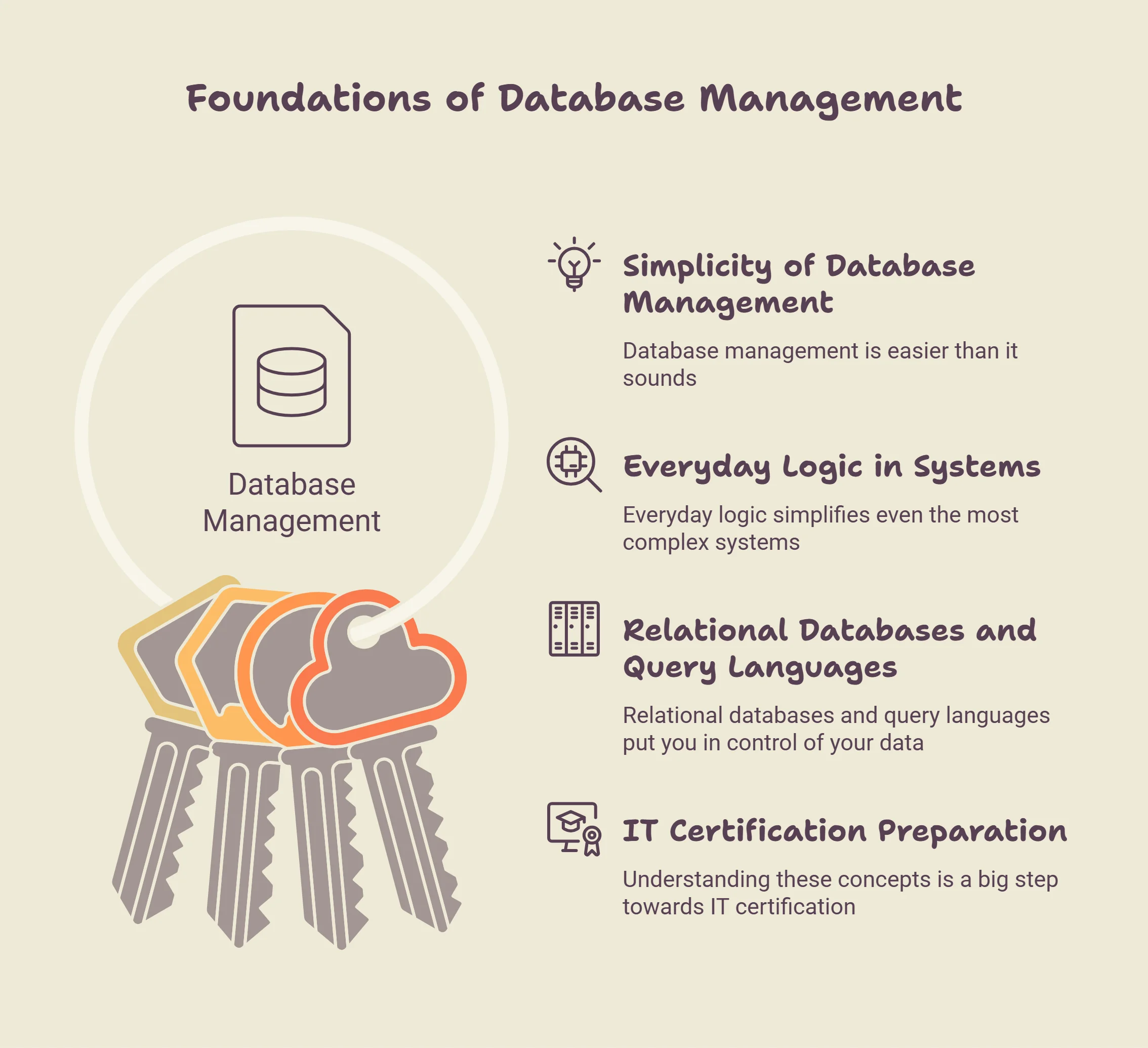
Database management is easier than it sounds
Everyday logic simplifies even the most complex systems
Relational databases and query languages put you in control of your data
Understanding these concepts is a big step towards IT certification

Conclusion: Start Your Database Management Journey Today
Learning database concepts for beginners explained using everyday logic unlocks the power to manage, organize, and grow with data in a digital world. It's time to think like a database pro—with confidence and a sense of humor!
Ready to take your foundational tech knowledge even further? As you build confidence with database concepts, consider exploring how these skills connect to broader IT certifications and security essentials. Our in-depth overview of cloud security essentials and certification pathways reveals how mastering data organization is just the beginning of your journey.
Discover how database management, cloud technology, and security best practices come together to future-proof your digital expertise and open doors to exciting career opportunities.
For More Great IT Certification Training Content, Visit: ITCertificationJump.com
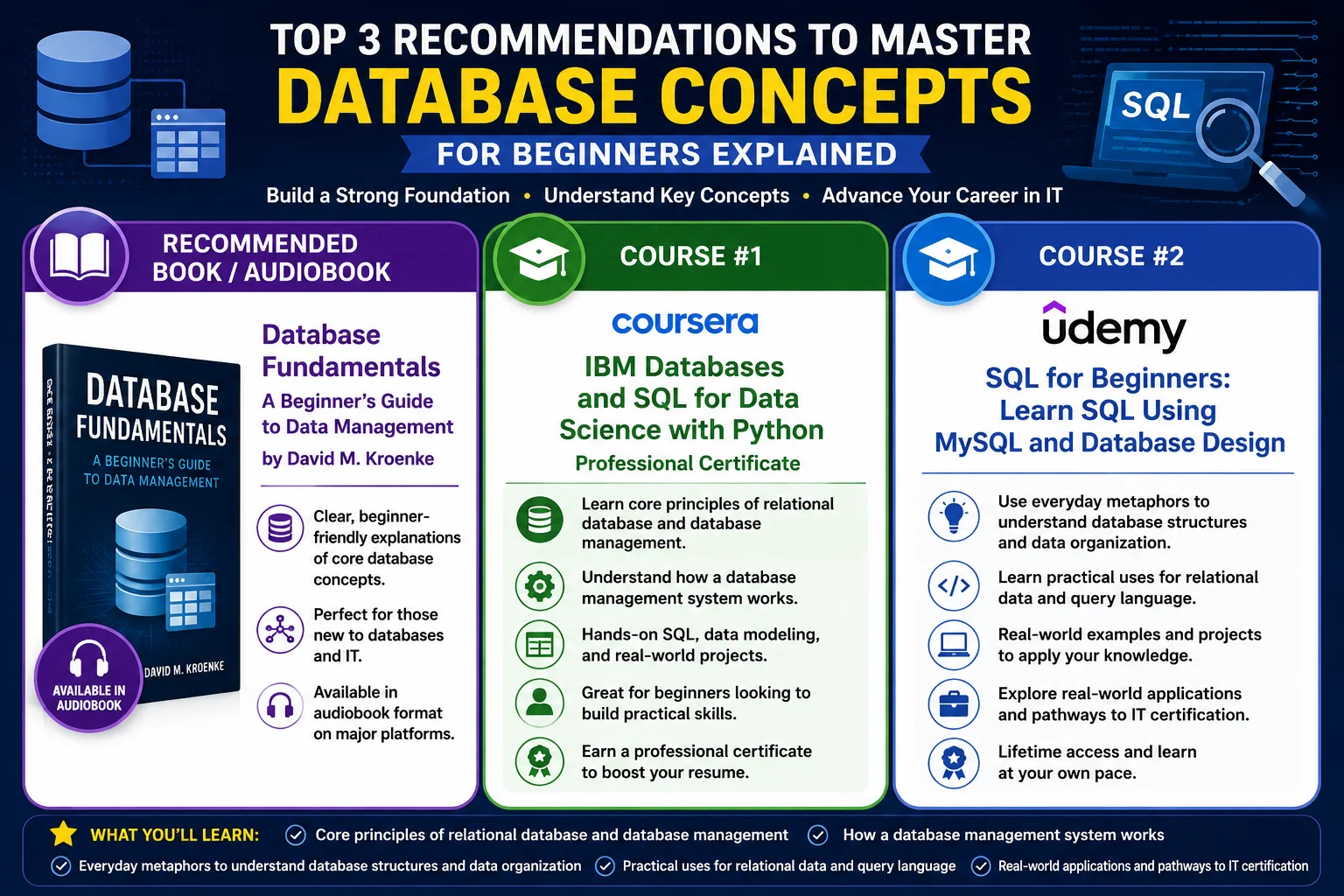
Want to understand databases without feeling like you need a computer science degree?
Start with Database Design for Mere Mortals to build a solid foundation, then take the IBM Databases and SQL for Data Science course and the SQL for Beginners course to gain practical skills that employers and certification programs value. This combination provides both conceptual understanding and hands-on experience with real-world databases.
Article Sources:
Oracle – What Is a Database?
IBM – What is a database?
Codecademy – What Is SQL: Common Uses and Defining Features
To deepen your understanding of database concepts, consider exploring the following resources:
Basic Database Concepts - This article provides a comprehensive overview of fundamental database principles, including data organization, database management systems, and the importance of data integrity. (geeksforgeeks. org)
Getting Started with Databases: Essential Guide for Beginners - This guide introduces key database concepts, such as different types of databases, their applications, and foundational knowledge necessary for beginners. (geeksforgeeks. org)
These resources offer clear explanations and practical examples to help you grasp the essentials of database management.




Write A Comment