

IT certification badge for professional development and career advancement
update

IT Certification Jump

update
  • Homepage
  • About
  • Good To Know
  • AI
  • Machine Learning
  • EXAM Traps 101
  • All Posts
  • Security
  • Cisco
  • CompTIA
  • AWS
  • Beginner
  • Cloud
  • Coding
  • Digital Forensics
  • EC-Council
  • Google
  • Java
  • Juniper
  • Linux
  • Microsoft
  • Project Management
  • Python
  • Uncategorized
  • Virtualization
  • VMware
  • Network Infrastructure
  • Hardware
  • Gaming
  • Good To Know
  • AI
  • Machine Learning
  • EXAM Traps 101
7 Minutes Read

Demystifying the Cloud: Why Non-Tech Professionals Should Consider the AWS Cloud Practitioner Certification

Diverse professionals collaborating on cloud technology, showcasing teamwork and innovation.

Demystifying the Cloud: Why Non-Tech Professionals Should Consider the AWS Cloud Practitioner Certification

Cloud computing isn't just for the IT department anymore. Whether you're in marketing, sales, finance, or running your own business, understanding the cloud has become as essential as knowing how to use email. Let's explore why the AWS Cloud Practitioner certification has become the go-to credential for non-technical professionals looking to boost their career prospects and better understand the digital backbone of modern business.

What Exactly is the AWS Cloud Practitioner Certification?

The AWS Cloud Practitioner is Amazon Web Services' foundational certification designed specifically with non-technical people in mind. Think of it as your friendly introduction to the world of cloud computing – no scary coding required!

According to AWS's official documentation, "The AWS Certified Cloud Practitioner examination is intended for individuals who have the knowledge and skills necessary to effectively demonstrate an overall understanding of the AWS Cloud, independent of specific technical roles."

In other words, it's perfect for anyone who wants to understand the cloud without needing to build it themselves.

Why Should Non-IT Professionals Care About Cloud Computing?

You might be thinking, "I work in marketing/sales/finance – why should I care about servers and cloud infrastructure?" Great question!

"Today, every company is a technology company, and executives across all business functions need to understand how to leverage technology to deliver value to customers," says Werner Vogels, CTO at Amazon. "Cloud fluency is becoming a prerequisite for roles beyond just IT."

Here's why cloud knowledge matters across all departments:

Better Communication with Technical Teams

Ever sat in a meeting where the IT folks were speaking what seemed like an entirely different language? With cloud knowledge, you'll not only understand what they're saying but contribute meaningfully to the conversation.

More Informed Business Decisions

When you understand the capabilities and costs of cloud services, you can make smarter decisions about digital initiatives and technology investments.

"Non-technical professionals who understand cloud fundamentals help organizations make better-informed decisions about technology adoption and usage," notes Gartner analyst Ed Anderson. "This knowledge bridges the gap between business needs and technical implementation."

Career Advancement

In a survey conducted by Global Knowledge, 52% of IT decision-makers indicated they look for cloud certifications when hiring for non-IT positions that interface with technology teams.

Attractive business woman proudly holding AWS Certificate for career success

Who Benefits Most from the AWS Cloud Practitioner Certification?

Business Leaders and Managers

As a manager or executive, understanding cloud capabilities helps you identify opportunities for efficiency, cost-saving, and innovation. You'll speak the same language as your technical teams and make more informed decisions about technology investments.

"For business leaders, cloud literacy isn't optional anymore—it's a competitive necessity," explains Bernard Golden, cloud computing advisor and author. "The Cloud Practitioner certification provides the perfect introduction to help executives understand how technology can drive business outcomes."

Sales and Marketing Professionals

If you're selling or marketing technology-related products or services, cloud knowledge gives you credibility. You'll better understand your customers' needs and communicate your solutions more effectively.

One marketing director I spoke with joked, "Getting my Cloud Practitioner certification meant I could finally stop nodding along in meetings pretending I knew what 'elastic computing' meant. Now I actually get it—and it's made me much better at my job!"

Finance and Procurement Teams

Cloud services represent significant expenditure for most companies today. Understanding cloud concepts helps finance professionals evaluate costs, understand billing models, and identify opportunities for optimization.

Entrepreneurs and Small Business Owners

As a business owner, the cloud can level the playing field, giving you access to enterprise-grade technology without massive upfront investments. Understanding your options helps you make strategic choices for your business.

Diverse office professionals at conference table

How Difficult Is It Really?

The great news is that AWS designed this certification specifically for non-technical people. No coding knowledge required!

"We created the Cloud Practitioner certification to be accessible to anyone, regardless of their technical background," explains Kevin Kelly, Director of AWS Certification. "It focuses on concepts and business benefits rather than deep technical implementations."

Most people prepare for the exam in 4-6 weeks of casual study. The exam consists of multiple-choice questions covering cloud concepts, security, technology, and billing/pricing models.

Real Benefits in the Workplace

I recently read about a sales executive who was interviewed and shared her experience:

"After getting certified, I not only understood my own company's cloud offerings better, but I could have much more intelligent conversations with my customers about their cloud journey. My win rate has definitely improved."

Another publication had an article where a marketing manager commented:

"I was always intimidated when our developers talked about AWS services. Now I can not only follow along, but I can suggest marketing campaigns that align with our technical capabilities. It's been a game-changer."

Getting Started

Ready to dip your toes into the cloud? Here are some steps to get started:

  1. Check out AWS's free digital training courses designed specifically for the Cloud Practitioner certification

  2. Join online communities like the AWS forums or LinkedIn groups focused on cloud learning

  3. Schedule your exam when you feel ready—it can be taken online from the comfort of your home

An easy entry point

Final Thoughts

In today's digital economy, cloud knowledge is business knowledge. The AWS Cloud Practitioner certification represents a low-barrier entry point into a crucial area of modern business that can distinguish you from peers and open new career opportunities.

As one certified professional put it:

"Getting my Cloud Practitioner certification was like getting a passport to a country where half my colleagues were already living. Suddenly, I could visit anytime and understand the local language. I only wish I'd done it sooner!"

Whether you're looking to advance your career, communicate better with technical teams, or simply understand the technology that powers modern business, the AWS Cloud Practitioner certification offers a surprisingly accessible path forward—even if the closest you've come to "technical" work is resetting your home WiFi router.

AWS Certification FAQ

Frequently Asked Questions: AWS Cloud Practitioner Certification

How much does the AWS Certified Cloud Practitioner cost?

The AWS Certified Cloud Practitioner exam costs $100 USD. This is Amazon's most affordable certification exam and serves as the entry point to their certification program. If you need to retake the exam, each additional attempt will also cost $100. Some employers offer reimbursement programs for certification costs, so it's worth checking with your HR department before paying out of pocket.

Can I learn AWS in 3 months?

Yes, three months is a realistic timeframe for learning AWS fundamentals, especially for the Cloud Practitioner certification. Most successful candidates allocate 40-60 hours of study spread over 1-3 months. The Cloud Practitioner certification is specifically designed to be accessible to beginners, focusing on broad concepts rather than technical implementations. With dedicated study of a few hours per week, three months provides ample time to prepare for and pass the exam.

How long does it take to learn AWS Cloud Practitioner?

Most candidates successfully prepare for the AWS Cloud Practitioner exam in 4-6 weeks with consistent study. The official AWS training course takes approximately 6 hours to complete, but additional time is needed for practice exams and reinforcing concepts. For non-technical professionals, allocating 1-2 hours per day over a month or 5-10 hours per week for 4-6 weeks is typically sufficient. Those with some technology background might prepare adequately in as little as 2-3 weeks.

How hard is AWS for beginners?

AWS Cloud Practitioner is specifically designed to be accessible to beginners and non-technical professionals. The exam focuses on cloud concepts, business benefits, and basic services rather than complex technical implementations. The pass rate is relatively high compared to other technical certifications, with most properly prepared candidates succeeding on their first attempt. The exam consists of multiple-choice and multiple-answer questions, without any hands-on technical tasks, making it approachable for newcomers to cloud computing.

How much does a cloud practitioner make?

Salaries for professionals with AWS Cloud Practitioner certification vary widely depending on role, location, industry, and additional skills/experience. According to recent salary data, professionals with this certification typically see a salary boost of 5-15% over non-certified peers in similar roles.

For dedicated cloud roles, entry-level positions often range from $60,000-$85,000 USD annually. However, it's important to note that the Cloud Practitioner certification is often more valuable as a supplement to existing professional skills rather than as a standalone qualification. For example, a marketing manager with cloud certification might command a higher salary than one without, even though their primary role isn't cloud-focused.

Which cloud certification is best?

The "best" cloud certification depends entirely on your career goals, current role, and technical background:

  • For non-technical professionals seeking broad cloud knowledge: AWS Cloud Practitioner

  • For those pursuing cloud engineering roles: AWS Solutions Architect Associate or Azure Administrator

  • For developers: AWS Developer Associate or Google Cloud Professional Cloud Developer

  • For data specialists: Google Cloud Professional Data Engineer or AWS Data Analytics Specialty

The AWS Cloud Practitioner is considered the most accessible entry point and has strong market recognition, which makes it particularly valuable for business professionals seeking to demonstrate cloud literacy.

How many attempts are allowed for the AWS Cloud Practitioner exam?

There is no limit to the number of times you can attempt the AWS Cloud Practitioner exam. However, you must wait 14 days between attempts at the same exam, and each attempt costs $100 USD. AWS doesn't publicly disclose how many attempts a candidate has made, so potential employers would not know if you needed multiple tries to pass. Most adequately prepared candidates pass on their first or second attempt.

Can you get a job with an AWS Cloud Practitioner certification?

The AWS Cloud Practitioner certification alone is typically not sufficient for dedicated technical cloud roles, as it's a foundational credential. However, it can be very valuable in several scenarios:

  1. As an entry point to start a cloud career path (often followed by more technical AWS certifications)

  2. For non-technical roles that interface with cloud teams (business analysts, project managers)

  3. For enhancing existing qualifications in sales, marketing, finance, or management positions

  4. For demonstrating cloud literacy when transitioning to tech-adjacent roles

Many companies now view cloud literacy as a differentiator even for non-technical positions, making this certification valuable across a wide range of careers. It's best viewed as a supplement to your existing skills and experience rather than a standalone qualification.
AWS Cloud

0 Comments

Write A Comment

*
*
Please complete the captcha to submit your comment.
Related Posts All Posts

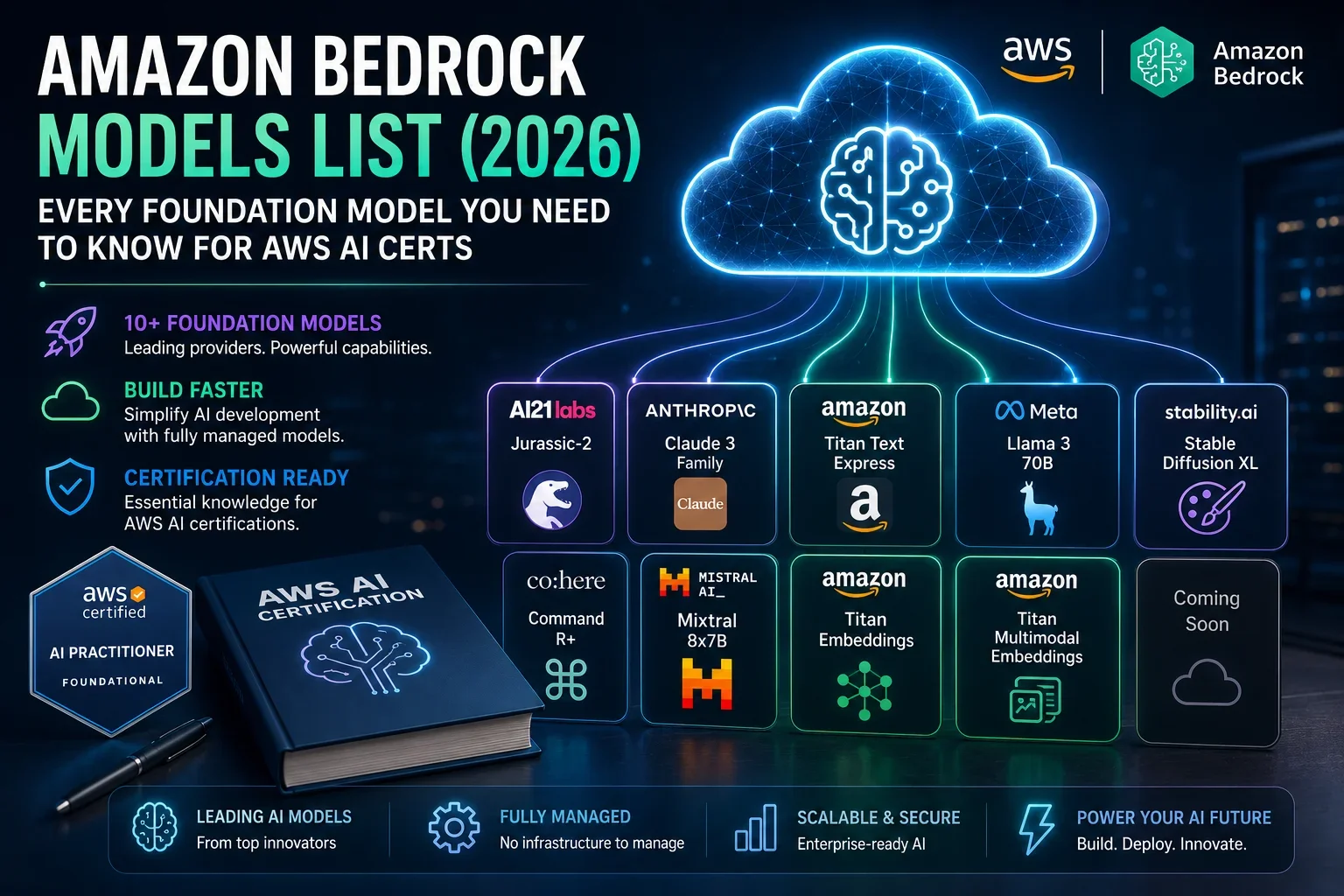
Amazon Bedrock Models List (2026): Every Foundation Model You Need to Know for AWS AI Certs

Did you know Amazon Bedrock offers over 10 foundational AI models designed to simplify building intelligent applications? Mastering these key models is essential for anyone pursuing AWS AI certifications, enabling faster, scalable, and more efficient AI solutions in today's competitive cloud landscape.In this definitive educational guide, we’ll break down the Amazon Bedrock models landscape for 2026, reveal how these provider models and foundation models align with AWS AI certification objectives, and equip you with expert strategies for choosing the right model family—so you can ace your certs and bring cutting-edge AI applications to life.Unlocking AWS AI Expertise: Why Amazon Bedrock Models Matter for Certification SuccessOverview of Amazon Bedrock modelsRelevance to AWS AI certifications and industry professionalsImpact on building modern, intelligent AI applicationsUnderstanding Amazon Bedrock models isn’t just a technical trend—it’s a core requirement for anyone looking to master AWS AI certifications and advance in cloud-based AI careers. The latest foundation models and wide selection of provider model options unlock new levels of capability, flexibility, and scalability for building AI applications. For industry professionals intent on staying relevant, Bedrock’s expanding model family choices offer a vital toolkit. Mastery of these models translates directly into success on AWS AI certification exams.Why? Because AWS is rapidly becoming the backbone for enterprise AI solutions. Foundational knowledge of Bedrock’s custom model support, image model innovations, and its open, extensible architecture means professionals can design, deploy, and maintain sophisticated generative AI systems.This expertise not only ensures cert success but also gives builders an edge in creating production-ready, scalable, and secure AI applications—meeting the growing demand for automated reasoning, intelligent prompt routing, and seamless data automation across industries.What You'll Learn About Amazon Bedrock ModelsComprehensive list of Amazon Bedrock foundation modelsInsights into provider model and foundation models for AWSExpert advice on data automation, image model, and ai applicationsHow to select the right model family for your AWS solutionsIntroducing Amazon Bedrock Models: Foundation and Provider Models BreakdownWhat is Amazon Bedrock and How Does It Power Foundation Models?The concept of foundation models in Amazon BedrockThe role of provider model in enabling custom model deploymentsCore benefits for scalable AI developmentAmazon Bedrock is AWS’s unified platform for deploying and managing foundation models from leading providers and AWS itself. These models form the backbone of next-generation ai applications—handling tasks such as language understanding, content generation, translation, summarization, and image recognition. At the heart of Bedrock is a flexible, provider model approach.This allows users to select pretrained or bring-your-own models, fine-tune them as custom models, and leverage the full spectrum of model output and advanced capabilities. Core benefits for scalable AI development include seamless integration through API calls, robust security for sensitive information, and optimizations for high-throughput, cost-efficient model inference.By centralizing foundation model access and supporting a diverse model family landscape, Amazon Bedrock empowers organizations to rapidly experiment, build, and deploy complex AI workloads. This architecture also means updates and new frontier models can be adopted quickly, enabling organizations to keep pace with advances in generative AI without reengineering their pipelines.Whether you’re deploying language models for intelligent prompt routing, harnessing image model capabilities for computer vision, or training a customized model for a unique business challenge, Bedrock acts as a single control point.For those interested in hands-on model training and understanding how foundational AI concepts translate across cloud platforms, exploring approaches to training AI models in Azure can provide valuable tactical insights. Comparing AWS Bedrock with Azure’s model training workflows helps deepen your grasp of cloud AI certification requirements and practical deployment strategies.Models from Leading Providers: Collaboration and ChoiceList of leading providers offering foundation models in Amazon BedrockThe value of open ecosystem and multiple model family supportAmazon Bedrock’s open design means it brings together models from leading providers worldwide, including AWS’s own Titan series, as well as partners like Anthropic, AI21 Labs, Cohere, Stability AI, and more. Each provider model offers distinct strengths, such as long context length, unique model output capabilities, and specific optimizations for different AI tasks.The open model family ecosystem isn’t just a technical advantage; it’s a strategic one, giving developers the freedom to choose the right foundation model for each workload without vendor lock-in."Understanding Amazon Bedrock models is now a core competency for any professional seeking AWS AI certification." — Dr. Samina Patel, AWS Certified Solutions ArchitectIn a world of rapidly evolving generative AI needs, access to a diverse array of foundation models means companies can pilot, iterate, and deploy production AI systems more quickly. It also supports advanced features like intelligent prompt routing and automated reasoning, further enabling teams to deliver innovative solutions—from chatbots and recommender systems to sophisticated analytics and computer vision platforms.Amazon Bedrock Models List: Complete Overview for 2026Provider ModelFoundation ModelModel FamilyModel TypeBest Use CaseAWS TitanTitan Text G4Text / Generative AIText Foundation ModelNatural language generation & summarizationAnthropicClaude 2 & 3Conversational AIText Foundation ModelChatbots, Q&A, complex reasoningAI21 LabsJurassic-2Text GenerationText Foundation ModelLong-form content, translationStability AIStable Diffusion 3Image GenerationImage ModelAsset creation, vision AICohereCommand RCustom ModelText/CommandSemantic search, document analysisMetaLlama 3Open ModelText Foundation ModelOpen-source pipelines, researchMistralMistral 8x22BText/Advanced ModelText Foundation ModelLarge-context tasks, AI applicationsDatabricksDBRXOpen ModelText Foundation ModelEnterprise analytics, data automationText Foundation Models in Amazon BedrockComprehensive list of text foundation modelsMain providers and model familiesAI applications best served by eachText foundation models are the cornerstone of most AWS AI cert logic and power a wide range of ai applications, from chatbot deployment to document generation. Major players on Bedrock include the Titan series by AWS, Anthropic’s Claude, AI21’s Jurassic models, and open solutions like Llama 3 and Mistral.Each provider model is optimized for specific use cases: Titan excels at summarization and scalable output, Claude is tailored for conversational AI with large context length handling, while AI21 offers strong multilingual support.When selecting a model family, consider unique features like native support for intelligent prompt routing, advanced context processing, and security protocols for handling sensitive information.For AWS certification, understanding which foundation model aligns with key skills (e. g. , API call integration, generating compliant model output, or supporting automated reasoning) sets you apart. These models are also ideal for exam scenarios that require working with custom data, text parsing, or enterprise-ready NLP tasks.Image Models and Advanced Model CapabilitiesExploration of image model features in Amazon BedrockAdvanced model capabilities and integration pathsAI applications for image recognition and computer visionImage models in Amazon Bedrock, like Stability AI’s Stable Diffusion and AWS’s own image solutions, provide essential infrastructure for computer vision and asset generation.These advanced models leverage deep learning to interpret, augment, and generate new images, making them invaluable for AI-powered design, automated surveillance, content moderation, and medical imaging applications. Integration is simple through API calls, and the model output can be routed into automated workflows.Advanced model features such as selective provisioned throughput, built-in prompt routing, and easy scaling options are crucial for organizations building production-ready solutions. Choosing the correct model family—for example, picking Stable Diffusion for creative image assets or Titan for automated visual inspection—ensures successful deployment.For AWS AI certifications, it’s essential to understand how to evaluate the right image model for contexts like data privacy, output requirements, and compliance, especially when custom workflows are needed.Custom Models and Model Family Selection in Amazon BedrockThe process of building and training custom modelsModel families suited for specialized tasks and data automationHow knowledge base integration enhances resultsWhile foundation models provide out-of-the-box power, Amazon Bedrock’s support for custom model building takes AI adoption to the next level. This process typically involves fine-tuning a provider model or starting from an existing foundation model, allowing teams to tailor the model output to specialized use cases—like legal reasoning, industry-specific jargon, or hyper-personalized content.With Bedrock, deploying a customized model is straightforward, involving training data upload, configuration of parameters such as context length, and then seamless deployment with intelligent prompt routing.Selecting the appropriate model family is essential for tasks like automated analytics (data automation), image-based workflows, or natural language understanding. Integration with the Amazon Bedrock knowledge base allows custom models to access and utilize organizational data, providing even more contextual accuracy and complex reasoning capability for your AI applications."The flexibility of custom model support in Amazon Bedrock allows organizations to tailor solutions for unique business challenges." — Linda Okafor, AI Industry AnalystData Automation and AI Applications: Leveraging Amazon Bedrock ModelsAutomating Data Workflows with Foundation ModelsStreamlining data automation with Bedrock foundation modelsExample applications in document processing and analyticsData automation is a must-have for large-scale AI projects, and Amazon Bedrock’s foundation models make this easier than ever. Automated data workflows use Bedrock models for tasks like document processing (OCR, extraction), analytics, and content categorization, feeding directly into data pipelines for faster, more accurate results.By leveraging built-in features like model inference scaling and secure API call integration, technical teams can offload repetitive, human-intensive tasks, freeing up time for high-level analysis and development.The model family chosen for data automation may depend on output requirements, input data complexity, or downstream compliance needs. AWS AI certification content frequently tests the ability to select, configure, and evaluate foundation models for automated workflows—making this a crucial practical skill. These capabilities are also vital for AI applications in finance, healthcare, and legal industries, where quick, reliable results from document analysis and data extraction are competitive differentiators.Innovative AI Applications Built on Amazon Bedrock ModelsCase examples: enterprise AI applicationsModel family selection for production-ready solutionsAmazon Bedrock serves as the engine behind innovative ai applications across industries. Enterprises leverage Bedrock’s rich model family palette to power everything from real-time translation and intelligent customer support to fraud detection and dynamic asset generation. Selecting between a custom model versus a pretrained foundation model depends on project objectives, available data, and compliance needs.Successful AWS AI certification exam scenarios often involve mapping real-world needs—like personalized recommendations, multi-language support, or instant document summarization—to the correct provider model or building a customized model on Bedrock. Knowing how to assess model versions, interpret model output, and select for specific downstream requirements sets professionals and project teams apart as they develop scalable, production-ready solutions.Amazon Bedrock Knowledge Base: Enhancing Intelligent SolutionsIntegrating the Knowledge Base with Foundation ModelsThe function of Amazon Bedrock knowledge baseEmpowering foundation models for contextual reasoningThe knowledge base is a unique feature of the Amazon Bedrock ecosystem, providing connected, trusted data that powers more accurate, context-aware foundation models. Integration is seamless—models access the knowledge base to ground their outputs, delivering results that are not only more precise but also aligned with organizational facts and requirements. This is vital for AWS AI cert objectives around contextual reasoning, as exams increasingly require test-takers to demonstrate best practices for data, privacy, and ethical AI application.By tying together AI applications with centralized information, Bedrock enables automated reasoning, complex problem-solving, and multilayered decision-making—environments where small model adjustments can make the difference between a good job and a world-class solution. This is also where custom models and the power of the knowledge base converge, supporting more nuanced and compliant AI adoption across industries.People Also Ask: Amazon Bedrock ModelsWhat are the AWS Bedrock models?AWS Bedrock models are advanced foundation models designed and hosted by Amazon and a wide range of leading AI providers. These models function as either pretrained foundation models or custom models that can be tailored to meet specific business or certification needs.Covering text foundation and image model types, each model belongs to a different model family—ensuring a suitable fit for a broad set of AI applications. They enable intelligent automation, generative AI, knowledge extraction, and more on AWS.How many models does Amazon Bedrock have?As of 2026, Amazon Bedrock offers over ten prominent foundation models and continues to expand. The exact count may change as new provider models and custom models are introduced. Each model family comes in multiple model types, such as text, image, and advanced models—with variations in context length, training data, and intended application scenarios, enabling comprehensive support for AI innovation.What foundation models are available in Amazon Bedrock?Amazon Bedrock showcases foundation models including AWS Titan, Anthropic Claude, AI21 Labs Jurassic, Stability AI’s Stable Diffusion, Cohere Command, Llama 3, Mistral, and Databricks DBRX. Each provider model offers specific model family traits—such as large-scale language understanding, fast image generation, or deep analytic capabilities—making them ideal for diverse AWS AI solutions.What is Amazon Bedrock used for?Amazon Bedrock is used to build, deploy, and manage large-scale, intelligent AI applications in the cloud. It’s essential for data automation, generative AI, and deploying scalable foundation models. Through its knowledge base and custom model support, Bedrock helps organizations accelerate time-to-value by automating tasks, enhancing productivity, and ensuring secure, compliant AI innovation.Choosing and Applying Amazon Bedrock Models for CertificationHow to align model family and provider model to cert objectivesKey foundation model preparation strategiesInsights on passing AWS AI certification exams with practical model applicationChoosing the right Amazon Bedrock models for AWS AI certifications means aligning model family strengths, provider model optimizations, and intended AI application scenarios. Start by mapping certification objectives to model capabilities: for natural language, favor text foundation models; for vision tasks, select an image model; for specialized needs, build a custom model with your data. Focus on deeply understanding each model’s API call parameters, context length limitations, and model output interpretation.Preparation strategies include practicing hands-on labs using different Bedrock models, experimenting with knowledge base integrations, and testing intelligent prompt routing between various model versions. For the exam, anticipate use cases involving both foundation and custom model deployments, covering scenarios like data automation, compliance, and generative AI scaling. Staying updated on new foundation and frontier models will keep your skills—and certifications—current in a rapidly evolving landscape.Essential FAQs on Amazon Bedrock ModelsCan I deploy multiple provider models in a single AWS solution?Yes. Amazon Bedrock supports combining multiple provider models within one AWS workflow, enabling multi-model pipelines for advanced AI applications and data automation tasks.What are the main differences between model families for text vs. image model types?Text foundation models are optimized for natural language understanding and generative output, while image models focus on processing, generating, or analyzing visual data. Model families are selected based on data input types and AI application goals.How does data automation improve using foundation models in Bedrock?Bedrock’s foundation models streamline data processing, extraction, and transformation—reducing manual effort and delivering faster, more accurate analytics for business workflows.Do custom models improve knowledge base performance?Absolutely. Custom models can be trained on your unique organizational data, allowing deeper integration with the knowledge base and better context-aware results for AI reasoning and compliance.Are updates to foundation models automatically deployed in Amazon Bedrock?Yes. Amazon Bedrock handles regular updates to foundation and provider models, ensuring you have access to the latest features, performance improvements, and security patches without application downtime.Key Takeaways for Mastering Amazon Bedrock ModelsMaster foundation models, image model, and custom model optionsLeverage model family and knowledge base for AI applicationsAlign Amazon Bedrock models to AWS certification exam successRead More on ITCertificationJump.com for Expert AWS AI TrainingFor more great IT certification training content, visit: ITCertificationJump.comIf you’re eager to expand your expertise beyond AWS and see how foundational AI model concepts apply across the cloud landscape, consider exploring how model training and deployment strategies differ in other environments. Our in-depth guide on training AI models in Azure offers a playful yet practical look at building, fine-tuning, and managing models in Microsoft’s ecosystem.By comparing AWS Bedrock with Azure’s approach, you’ll gain a broader perspective on cloud AI certifications, discover transferable skills, and unlock new strategies for real-world AI innovation—empowering you to become a truly versatile cloud AI professional.Now you’re equipped to navigate the entire Amazon Bedrock model ecosystem—leverage this knowledge for exam success and real-world AI impact.AWS Bedrock – https://aws.amazon.com/bedrock/AWS Bedrock User Guide – https://docs.aws.amazon.com/bedrock/latest/userguide/what-is-bedrock.htmlAnthropic – https://www.anthropic.comStability AI – https://www.stability.aiAI21 Labs – https://www.ai21.comAmazon Bedrock offers a diverse array of foundation models from leading AI providers, enabling developers to build and scale generative AI applications efficiently. Notable additions include OpenAI’s GPT-5.5 and GPT-5.4 models, which are now available on Amazon Bedrock, providing advanced capabilities for various AI tasks. (aboutamazon.com)Also know that Meta’s Llama 4 models, such as Llama 4 Scout 17B and Llama 4 Maverick 17B, have been integrated into Amazon Bedrock, offering enhanced performance and versatility for AI applications. (aboutamazon.com) These integrations expand the range of tools available to developers, facilitating the creation of sophisticated AI solutions on AWS.ITCertificationJump.com

Encryption: The Secret Language That Protects Your Data

Encryption explained: data at rest, data in transit, HTTPS, VPNs & mobile security. A beginner-friendly guide for teens exploring IT careers.

The 5 Security Concepts That Protect the Internet

Cybersecurity concepts explained: confidentiality, integrity, availability, authentication & authorization. A beginner-friendly guide for teens exploring IT careers.

© 2026 IT Certification Jump All Rights Reserved. Reston, VA 20190, , . Contact Us . Terms of Service . Privacy Policy

eyJjb21wYW55IjoiSVQgQ2VydGlmaWNhdGlvbiBKdW1wIiwiYWRkcmVzcyI6IlJlc3RvbiwgVkEgMjAxOTAiLCJjaXR5IjoiICIsInN0YXRlIjoiICIsInppcCI6IiAiLCJlbWFpbCI6InN1cHBvcnRAaXRjamdyb3VwLmNvbSIsInRvcyI6IlBIQStQSE4wY205dVp6NDhaVzArVjJobGJpQjViM1VnYzJsbmJpMXBiaUIzYVhSb0lIVnpMQ0I1YjNVZ1lYSmxJR2RwZG1sdVp5WnVZbk53T3lCNWIzVnlJSEJsY20xcGMzTnBiMjRnWVc1a0lHTnZibk5sYm5RZ2RHOGdjMlZ1WkNCNWIzVWdaVzFoYVd3Z1lXNWtMMjl5SUZOTlV5QjBaWGgwSUcxbGMzTmhaMlZ6TGlCQ2VTQmphR1ZqYTJsdVp5QjBhR1VnVkdWeWJYTWdZVzVrSUVOdmJtUnBkR2x2Ym5NZ1ltOTRJR0Z1WkNCaWVTQnphV2R1YVc1bklHbHVJSGx2ZFNCaGRYUnZiV0YwYVdOaGJHeDVJR052Ym1acGNtMGdkR2hoZENCNWIzVWdZV05qWlhCMElHRnNiQ0IwWlhKdGN5QnBiaUIwYUdseklHRm5jbVZsYldWdWRDNDhMMlZ0UGp3dmMzUnliMjVuUGp3dmNENEtDanh3UGp4aElHaHlaV1k5SW1oMGRIQTZMeTkzZDNjdVoyOXZaMnhsTG1OdmJTSSthSFIwY0RvdkwzZDNkeTVuYjI5bmJHVXVZMjl0UEM5aFBqd3ZjRDRLQ2p4d1BpWnVZbk53T3p3dmNENEtDanh3UGp4emRISnZibWMrVTBWU1ZrbERSVHd2YzNSeWIyNW5Qand2Y0Q0S0NqeHdQbGRsSUhCeWIzWnBaR1VnWVNCelpYSjJhV05sSUhSb1lYUWdZM1Z5Y21WdWRHeDVJR0ZzYkc5M2N5QjViM1VnZEc4Z2NtVmpaV2wyWlNCeVpYRjFaWE4wY3lCbWIzSWdabVZsWkdKaFkyc3NJR052YlhCaGJua2dhVzVtYjNKdFlYUnBiMjRzSUhCeWIyMXZkR2x2Ym1Gc0lHbHVabTl5YldGMGFXOXVMQ0JqYjIxd1lXNTVJR0ZzWlhKMGN5d2dZMjkxY0c5dWN5d2daR2x6WTI5MWJuUnpJR0Z1WkNCdmRHaGxjaUJ1YjNScFptbGpZWFJwYjI1eklIUnZJSGx2ZFhJZ1pXMWhhV3dnWVdSa2NtVnpjeUJoYm1RdmIzSWdZMlZzYkhWc1lYSWdjR2h2Ym1VZ2IzSWdaR1YyYVdObExpQlpiM1VnZFc1a1pYSnpkR0Z1WkNCaGJtUWdZV2R5WldVZ2RHaGhkQ0IwYUdVZ1UyVnlkbWxqWlNCcGN5QndjbTkyYVdSbFpDQW1jWFZ2ZER0QlV5MUpVeVp4ZFc5ME95QmhibVFnZEdoaGRDQjNaU0JoYzNOMWJXVWdibThnY21WemNHOXVjMmxpYVd4cGRIa2dabTl5SUhSb1pTQjBhVzFsYkdsdVpYTnpMQ0JrWld4bGRHbHZiaXdnYldsekxXUmxiR2wyWlhKNUlHOXlJR1poYVd4MWNtVWdkRzhnYzNSdmNtVWdZVzU1SUhWelpYSWdZMjl0YlhWdWFXTmhkR2x2Ym5NZ2IzSWdjR1Z5YzI5dVlXeHBlbUYwYVc5dUlITmxkSFJwYm1kekxqd3ZjRDRLQ2p4d1BsbHZkU0JoY21VZ2NtVnpjRzl1YzJsaWJHVWdabTl5SUc5aWRHRnBibWx1WnlCaFkyTmxjM01nZEc4Z2RHaGxJRk5sY25acFkyVWdZVzVrSUhSb1lYUWdZV05qWlhOeklHMWhlU0JwYm5admJIWmxJSFJvYVhKa0lIQmhjblI1SUdabFpYTWdLSE4xWTJnZ1lYTWdVMDFUSUhSbGVIUWdiV1Z6YzJGblpYTXNJRWx1ZEdWeWJtVjBJSE5sY25acFkyVWdjSEp2ZG1sa1pYSWdiM0lnWTJWc2JIVnNZWElnWVdseWRHbHRaU0JqYUdGeVoyVnpLUzRnV1c5MUlHRnlaU0J5WlhOd2IyNXphV0pzWlNCbWIzSWdkR2h2YzJVZ1ptVmxjeXdnYVc1amJIVmthVzVuSUhSb2IzTmxJR1psWlhNZ1lYTnpiMk5wWVhSbFpDQjNhWFJvSUhSb1pTQmthWE53YkdGNUlHOXlJR1JsYkdsMlpYSjVJRzltSUdWaFkyZ2dVMDFUSUhSbGVIUWdiV1Z6YzJGblpTQnpaVzUwSUhSdklIbHZkU0JpZVNCMWN5NGdTVzRnWVdSa2FYUnBiMjRzSUhsdmRTQnRkWE4wSUhCeWIzWnBaR1VnWVc1a0lHRnlaU0J5WlhOd2IyNXphV0pzWlNCbWIzSWdZV3hzSUdWeGRXbHdiV1Z1ZENCdVpXTmxjM05oY25rZ2RHOGdZV05qWlhOeklIUm9aU0JUWlhKMmFXTmxJR0Z1WkNCeVpXTmxhWFpsSUhSb1pTQlRUVk1nZEdWNGRDQnRaWE56WVdkbGN5NGdWMlVnWkc4Z2JtOTBJR05vWVhKblpTQmhibmtnWm1WbGN5Qm1iM0lnWkdWc2FYWmxjbmtnYjJZZ1pXMWhhV3dnYjNJZ1UwMVRMaUJVYUdseklHbHpJR0VnWm5KbFpTQnpaWEoyYVdObElIQnliM1pwWkdWa0lHSjVJSFZ6TGlCSWIzZGxkbVZ5TENCd2JHVmhjMlVnWTJobFkyc2dkMmwwYUNCNWIzVnlJR2x1ZEdWeWJtVjBJSE5sY25acFkyVWdjSEp2ZG1sa1pYSWdZVzVrSUdObGJHeDFiR0Z5SUdOaGNuSnBaWElnWm05eUlHRnVlU0JqYUdGeVoyVnpJSFJvWVhRZ2JXRjVJR2x1WTNWeUlHRnpJR0VnY21WemRXeDBJR1p5YjIwZ2NtVmpaV2wyYVc1bklHVnRZV2xzSUdGdVpDQlRUVk1nZEdWNGRDQnRaWE56WVdkbGN5QjBhR0YwSUhkbElHUmxiR2wyWlhJZ2RYQnZiaUI1YjNWeUlHOXdkQzFwYmlCaGJtUWdjbVZuYVhOMGNtRjBhVzl1SUhkcGRHZ2diM1Z5SUdWdFlXbHNJR0Z1WkNCVFRWTWdjMlZ5ZG1salpYTXVJRmx2ZFNCallXNGdZMkZ1WTJWc0lHRjBJR0Z1ZVNCMGFXMWxMaUJLZFhOMElIUmxlSFFnSm5GMWIzUTdVMVJQVUNaeGRXOTBPeUIwYnlBOGFHbG5hR3hwWjJoMElHTnNZWE56UFNKamIyMXdZVzU1VUdodmJtVlZjR1JoZEdVaVBpc3hPVEU1TlRrd056ZzROend2YUdsbmFHeHBaMmgwUGk0Z1FXWjBaWElnZVc5MUlITmxibVFnZEdobElGTk5VeUJ0WlhOellXZGxJQ1p4ZFc5ME8xTlVUMUFtY1hWdmREc2dkRzhnZFhNc0lIZGxJSGRwYkd3Z2MyVnVaQ0I1YjNVZ1lXNGdVMDFUSUcxbGMzTmhaMlVnZEc4Z1kyOXVabWx5YlNCMGFHRjBJSGx2ZFNCb1lYWmxJR0psWlc0Z2RXNXpkV0p6WTNKcFltVmtMaUJCWm5SbGNpQjBhR2x6TENCNWIzVWdkMmxzYkNCdWJ5QnNiMjVuWlhJZ2NtVmpaV2wyWlNCVFRWTWdiV1Z6YzJGblpYTWdabkp2YlNCMWN5NDhMM0ErQ2dvOGNENDhjM1J5YjI1blBsbFBWVklnVWtWSFNWTlVVa0ZVU1U5T0lFOUNURWxIUVZSSlQwNVRQQzl6ZEhKdmJtYytQQzl3UGdvS1BIQStTVzRnWTI5dWMybGtaWEpoZEdsdmJpQnZaaUI1YjNWeUlIVnpaU0J2WmlCMGFHVWdVMlZ5ZG1salpTd2dlVzkxSUdGbmNtVmxJSFJ2T2p3dmNENEtDanh2YkQ0S0NUeHNhVDV3Y205MmFXUmxJSFJ5ZFdVc0lHRmpZM1Z5WVhSbExDQmpkWEp5Wlc1MElHRnVaQ0JqYjIxd2JHVjBaU0JwYm1admNtMWhkR2x2YmlCaFltOTFkQ0I1YjNWeWMyVnNaaUJoY3lCd2NtOXRjSFJsWkNCaWVTQjBhR1VnVTJWeWRtbGpaU1lqTXprN2N5QnlaV2RwYzNSeVlYUnBiMjRnWm05eWJTQW9jM1ZqYUNCcGJtWnZjbTFoZEdsdmJpQmlaV2x1WnlCMGFHVWdKbkYxYjNRN1VtVm5hWE4wY21GMGFXOXVJRVJoZEdFbWNYVnZkRHNwSUdGdVpEd3ZiR2srQ2drOGJHaytiV0ZwYm5SaGFXNGdZVzVrSUhCeWIyMXdkR3g1SUhWd1pHRjBaU0IwYUdVZ1VtVm5hWE4wY21GMGFXOXVJRVJoZEdFZ2RHOGdhMlZsY0NCcGRDQjBjblZsTENCaFkyTjFjbUYwWlN3Z1kzVnljbVZ1ZENCaGJtUWdZMjl0Y0d4bGRHVXVJRWxtSUhsdmRTQndjbTkyYVdSbElHRnVlU0JwYm1admNtMWhkR2x2YmlCMGFHRjBJR2x6SUhWdWRISjFaU3dnYVc1aFkyTjFjbUYwWlN3Z2JtOTBJR04xY25KbGJuUWdiM0lnYVc1amIyMXdiR1YwWlN3Z2IzSWdkMlVnYUdGMlpTQnlaV0Z6YjI1aFlteGxJR2R5YjNWdVpITWdkRzhnYzNWemNHVmpkQ0IwYUdGMElITjFZMmdnYVc1bWIzSnRZWFJwYjI0Z2FYTWdkVzUwY25WbExDQnBibUZqWTNWeVlYUmxMQ0J1YjNRZ1kzVnljbVZ1ZENCdmNpQnBibU52YlhCc1pYUmxMQ0IzWlNCb1lYWmxJSFJvWlNCeWFXZG9kQ0IwYnlCemRYTndaVzVrSUc5eUlEeHpkSEp2Ym1jK1BITndZVzRnYzNSNWJHVTlJbU52Ykc5eU9pTkdSakF3TURBN0lqNTBaWEp0YVc1aGRHVWdlVzkxY2lCaFkyTnZkVzUwTDNCeWIyWnBiR1VnWVc1a0lISmxablZ6WlNCaGJua2dZVzVrSUdGc2JDQmpkWEp5Wlc1MElHOXlJR1oxZEhWeVpTQjFjMlVnYjJZZ2RHaGxJRk5sY25acFkyVWdLRzl5SUdGdWVTQndiM0owYVc5dUlIUm9aWEpsYjJZcExqd3ZjM0JoYmo0OEwzTjBjbTl1Wno0OEwyeHBQZ284TDI5c1Bnb0tQSEErSm01aWMzQTdQQzl3UGdvOGFHbG5hR3hwWjJoMElHTnNZWE56UFNKamIyMXdZVzU1VG1GdFpWVndaR0YwWlNJK1NWUWdRMlZ5ZEdsbWFXTmhkR2x2YmlCS2RXMXdQQzlvYVdkb2JHbG5hSFErUEdKeUlDOCtDanhvYVdkb2JHbG5hSFFnWTJ4aGMzTTlJbU52YlhCaGJubEJaR1J5WlhOelZYQmtZWFJsSWo1U1pYTjBiMjRzSUZaQklESXdNVGt3TENBc0lEd3ZhR2xuYUd4cFoyaDBQanhpY2lBdlBnbzhhR2xuYUd4cFoyaDBJR05zWVhOelBTSmpiMjF3WVc1NVVHaHZibVZWY0dSaGRHVWlQaXN4T1RFNU5Ua3dOemc0Tnp3dmFHbG5hR3hwWjJoMFBqeGljaUF2UGdvOGFHbG5hR3hwWjJoMElHTnNZWE56UFNKamIyMXdZVzU1UlcxaGFXeFZjR1JoZEdVaVBuTjFjSEJ2Y25SQWFYUmphbWR5YjNWd0xtTnZiVHd2YUdsbmFHeHBaMmgwUGc9PSIsInByaXZhY3kiOiJQSEErUEhOMGNtOXVaejVRVWtsV1FVTlpQQzl6ZEhKdmJtYytQQzl3UGdvS1BIQStQSE4wY205dVp6NVVhR1VnYVc1bWIzSnRZWFJwYjI0Z2NISnZkbWxrWldRZ1pIVnlhVzVuSUhSb2FYTWdjbVZuYVhOMGNtRjBhVzl1SUdseklHdGxjSFFnY0hKcGRtRjBaU0JoYm1RZ1kyOXVabWxrWlc1MGFXRnNMQ0JoYm1RZ2QybHNiQ0J1WlhabGNpQmlaU0JrYVhOMGNtbGlkWFJsWkN3Z1kyOXdhV1ZrTENCemIyeGtMQ0IwY21Ga1pXUWdiM0lnY0c5emRHVmtJR2x1SUdGdWVTQjNZWGtzSUhOb1lYQmxJRzl5SUdadmNtMHVJRlJvYVhNZ2FYTWdiM1Z5SUdkMVlYSmhiblJsWlM0OEwzTjBjbTl1Wno0OEwzQStDZ284Y0Q0OGMzUnliMjVuUGtsT1JFVk5Ua2xVV1R3dmMzUnliMjVuUGp3dmNENEtDanh3UGp4bGJUNVpiM1VnWVdkeVpXVWdkRzhnYVc1a1pXMXVhV1o1SUdGdVpDQm9iMnhrSUhWekxDNGdZVzVrSUdsMGN5QnpkV0p6YVdScFlYSnBaWE1zSUdGbVptbHNhV0YwWlhNc0lHOW1abWxqWlhKekxDQmhaMlZ1ZEhNc0lHTnZMV0p5WVc1a1pYSnpJRzl5SUc5MGFHVnlJSEJoY25SdVpYSnpMQ0JoYm1RZ1pXMXdiRzk1WldWekxDQm9ZWEp0YkdWemN5Qm1jbTl0SUdGdWVTQmpiR0ZwYlNCdmNpQmtaVzFoYm1Rc0lHbHVZMngxWkdsdVp5QnlaV0Z6YjI1aFlteGxJR0YwZEc5eWJtVjVjeVlqTXprN0lHWmxaWE1zSUcxaFpHVWdZbmtnWVc1NUlIUm9hWEprSUhCaGNuUjVJR1IxWlNCMGJ5QnZjaUJoY21semFXNW5JRzkxZENCdlppQkRiMjUwWlc1MElIbHZkU0J5WldObGFYWmxMQ0J6ZFdKdGFYUXNJSEpsY0d4NUxDQndiM04wTENCMGNtRnVjMjFwZENCdmNpQnRZV3RsSUdGMllXbHNZV0pzWlNCMGFISnZkV2RvSUhSb1pTQlRaWEoyYVdObExDQjViM1Z5SUhWelpTQnZaaUIwYUdVZ1UyVnlkbWxqWlN3Z2VXOTFjaUJqYjI1dVpXTjBhVzl1SUhSdklIUm9aU0JUWlhKMmFXTmxMQ0I1YjNWeUlIWnBiMnhoZEdsdmJpQnZaaUIwYUdVZ1ZFOVRMQ0J2Y2lCNWIzVnlJSFpwYjJ4aGRHbHZiaUJ2WmlCaGJua2djbWxuYUhSeklHOW1JR0Z1YjNSb1pYSXVQQzlsYlQ0OEwzQStDZ284Y0Q0OGMzUnliMjVuUGtSSlUwTk1RVWxOUlZJZ1QwWWdWMEZTVWtGT1ZFbEZVend2YzNSeWIyNW5Qand2Y0Q0S0NqeHdQanh6ZEhKdmJtYytXVTlWSUVWWVVGSkZVMU5NV1NCVlRrUkZVbE5VUVU1RUlFRk9SQ0JCUjFKRlJTQlVTRUZVT2p3dmMzUnliMjVuUGp3dmNENEtDanh2YkQ0S0NUeHNhVDVaVDFWU0lGVlRSU0JQUmlCVVNFVWdVMFZTVmtsRFJTQkpVeUJCVkNCWlQxVlNJRk5QVEVVZ1VrbFRTeTRnVkVoRklGTkZVbFpKUTBVZ1NWTWdVRkpQVmtsRVJVUWdUMDRnUVU0Z0puRjFiM1E3UVZNZ1NWTW1jWFZ2ZERzZ1FVNUVJQ1p4ZFc5ME8wRlRJRUZXUVVsTVFVSk1SU1p4ZFc5ME95QkNRVk5KVXk0Z0xDNGdRVTVFSUZWVExDQkpWQ1lqTXprN1V5QkRWVk5VVDAxRlVsTXNJRVZZVUZKRlUxTk1XU0JFU1ZORFRFRkpUVk1nUVV4TUlGZEJVbEpCVGxSSlJWTWdUMFlnUVU1WklFdEpUa1FzSUZkSVJWUklSVklnUlZoUVVrVlRVeUJQVWlCSlRWQk1TVVZFTENCSlRrTk1WVVJKVGtjc0lFSlZWQ0JPVDFRZ1RFbE5TVlJGUkNCVVR5QlVTRVVnU1UxUVRFbEZSQ0JYUVZKU1FVNVVTVVZUSUU5R0lFMUZVa05JUVU1VVFVSkpURWxVV1N3Z1JrbFVUa1ZUVXlCR1QxSWdRU0JRUVZKVVNVTlZURUZTSUZCVlVsQlBVMFVnUVU1RUlFNVBUaTFKVGtaU1NVNUhSVTFGVGxRdVBDOXNhVDRLQ1R4c2FUNU5RVXRGVXlCT1R5QlhRVkpTUVU1VVdTQlVTRUZVSUNocEtTQlVTRVVnVTBWU1ZrbERSU0JYU1V4TUlFMUZSVlFnV1U5VlVpQlNSVkZWU1ZKRlRVVk9WRk1zSUNocGFTa2dWRWhGSUZORlVsWkpRMFVnVjBsTVRDQkNSU0JWVGtsT1ZFVlNVbFZRVkVWRUxDQlVTVTFGVEZrc0lGTkZRMVZTUlN3Z1QxSWdSVkpTVDFJdFJsSkZSU3dnS0dscGFTa2dWRWhGSUZKRlUxVk1WRk1nVkVoQlZDQk5RVmtnUWtVZ1QwSlVRVWxPUlVRZ1JsSlBUU0JVU0VVZ1ZWTkZJRTlHSUZSSVJTQlRSVkpXU1VORklGZEpURXdnUWtVZ1FVTkRWVkpCVkVVZ1QxSWdVa1ZNU1VGQ1RFVXNJRUZPUkNBb2FYWXBJRUZPV1NCRlVsSlBVbE1nU1U0Z1ZFaEZJRk5QUmxSWFFWSkZJRmRKVEV3Z1FrVWdRMDlTVWtWRFZFVkVMand2YkdrK0NnazhiR2srUVU1WklFMUJWRVZTU1VGTUlFUlBWMDVNVDBGRVJVUWdUMUlnVDFSSVJWSlhTVk5GSUU5Q1ZFRkpUa1ZFSUZSSVVrOVZSMGdnVkVoRklGVlRSU0JQUmlCVVNFVWdVMFZTVmtsRFJTQkpVeUJFVDA1RklFRlVJRmxQVlZJZ1QxZE9JRVJKVTBOU1JWUkpUMDRnUVU1RUlGSkpVMHNnUVU1RUlGUklRVlFnV1U5VklGZEpURXdnUWtVZ1UwOU1SVXhaSUZKRlUxQlBUbE5KUWt4RklFWlBVaUJCVGxrZ1JFRk5RVWRGSUZSUElGbFBWVklnUTA5TlVGVlVSVklnVTFsVFZFVk5JRTlTSUV4UFUxTWdUMFlnUkVGVVFTQlVTRUZVSUZKRlUxVk1WRk1nUmxKUFRTQlVTRVVnUkU5WFRreFBRVVFnVDBZZ1FVNVpJRk5WUTBnZ1RVRlVSVkpKUVV3dVBDOXNhVDRLQ1R4c2FUNU9UeUJCUkZaSlEwVWdUMUlnU1U1R1QxSk5RVlJKVDA0c0lGZElSVlJJUlZJZ1QxSkJUQ0JQVWlCWFVrbFVWRVZPTENCUFFsUkJTVTVGUkNCQ1dTQlpUMVVnUmxKUFRTQlBVaUJVU0ZKUFZVZElJRTlTSUVaU1QwMGdWRWhGSUZORlVsWkpRMFVnVTBoQlRFd2dRMUpGUVZSRklFRk9XU0JYUVZKU1FVNVVXU0JPVDFRZ1JWaFFVa1ZUVTB4WklGTlVRVlJGUkNCSlRpQlVTRVVnVkU5VExqd3ZiR2srQ2p3dmIydytDZ284Y0Q0OGMzUnliMjVuUGt4SlRVbFVRVlJKVDA0Z1QwWWdURWxCUWtsTVNWUlpQQzl6ZEhKdmJtYytQQzl3UGdvS1BIQStXVTlWSUVWWVVGSkZVMU5NV1NCVlRrUkZVbE5VUVU1RUlFRk9SQ0JCUjFKRlJTQlVTRUZVSUVGT1JDQlRTRUZNVENCT1QxUWdRa1VnVEVsQlFreEZJRVpQVWlCQlRsa2dSRWxTUlVOVUxDQkpUa1JKVWtWRFZDd2dTVTVEU1VSRlRsUkJUQ3dnVTFCRlEwbEJUQ3dnUTA5T1UwVlJWVVZPVkVsQlRDQlBVaUJGV0VWTlVFeEJVbGtnUkVGTlFVZEZVeXdnU1U1RFRGVkVTVTVISUVKVlZDQk9UMVFnVEVsTlNWUkZSQ0JVVHl3Z1JFRk5RVWRGVXlCR1QxSWdURTlUVXlCUFJpQlFVazlHU1ZSVExDQkhUMDlFVjBsTVRDd2dWVk5GTENCRVFWUkJJRTlTSUU5VVNFVlNJRWxPVkVGT1IwbENURVVnVEU5VFUwVlRJQ2hGVmtWT0lFbEdJRWhCVXlCQ1JVVk9JRUZFVmtsVFJVUWdUMFlnVkVoRklGQlBVMU5KUWtsTVNWUlpJRTlHSUZOVlEwZ2dSRUZOUVVkRlV5a3NJRkpGVTFWTVZFbE9SeUJHVWs5Tk9qd3ZjRDRLQ2p4dmJENEtDVHhzYVQ1VVNFVWdWVk5GSUU5U0lGUklSU0JKVGtGQ1NVeEpWRmtnVkU4Z1ZWTkZJRlJJUlNCVFJWSldTVU5GT3p3dmJHaytDZ2s4YkdrK1ZFaEZJRU5QVTFRZ1QwWWdVRkpQUTFWU1JVMUZUbFFnVDBZZ1UxVkNVMVJKVkZWVVJTQkhUMDlFVXlCQlRrUWdVMFZTVmtsRFJWTWdVa1ZUVlV4VVNVNUhJRVpTVDAwZ1FVNVpJRWRQVDBSVExDQkVRVlJCTENCSlRrWlBVazFCVkVsUFRpQlBVaUJUUlZKV1NVTkZVeUJRVlZKRFNFRlRSVVFnVDFJZ1QwSlVRVWxPUlVRZ1QxSWdUVVZUVTBGSFJWTWdVa1ZEUlVsV1JVUWdUMUlnVkZKQlRsTkJRMVJKVDA1VElFVk9WRVZTUlVRZ1NVNVVUeUJVU0ZKUFZVZElJRTlTSUVaU1QwMGdWRWhGSUZORlVsWkpRMFU3UEM5c2FUNEtDVHhzYVQ1VlRrRlZWRWhQVWtsYVJVUWdRVU5EUlZOVElGUlBJRTlTSUVGTVZFVlNRVlJKVDA0Z1QwWWdXVTlWVWlCVVVrRk9VMDFKVTFOSlQwNVRJRTlTSUVSQlZFRTdQQzlzYVQ0S0NUeHNhVDVUVkVGVVJVMUZUbFJUSUU5U0lFTlBUa1JWUTFRZ1QwWWdRVTVaSUZSSVNWSkVJRkJCVWxSWklFOU9JRlJJUlNCVFJWSldTVU5GT3lCUFVqd3ZiR2srQ2drOGJHaytRVTVaSUU5VVNFVlNJRTFCVkZSRlVpQlNSVXhCVkVsT1J5QlVUeUJVU0VVZ1UwVlNWa2xEUlM0OEwyeHBQZ284TDI5c1Bnb0tQSEErUEhVK1Fua2djbVZuYVhOMFpYSnBibWNnWVc1a0lITjFZbk5qY21saWFXNW5JSFJ2SUc5MWNpQmxiV0ZwYkNCaGJtUWdVMDFUSUhObGNuWnBZMlVzSUdKNUlHOXdkQzFwYml3Z2IyNXNhVzVsSUhKbFoybHpkSEpoZEdsdmJpQnZjaUJpZVNCbWFXeHNhVzVuSUc5MWRDQmhJR05oY21Rc0lDWnhkVzkwTzNsdmRTQmhaM0psWlNCMGJ5QjBhR1Z6WlNCVVJWSk5VeUJQUmlCVFJWSldTVU5GSm5GMWIzUTdJR0Z1WkNCNWIzVWdZV05yYm05M2JHVmtaMlVnWVc1a0lIVnVaR1Z5YzNSaGJtUWdkR2hsSUdGaWIzWmxJSFJsY20xeklHOW1JSE5sY25acFkyVWdiM1YwYkdsdVpXUWdZVzVrSUdSbGRHRnBiR1ZrSUdadmNpQjViM1VnZEc5a1lYa3VQQzkxUGp3dmNENEtDanh3UGladVluTndPend2Y0Q0S1BHaHBaMmhzYVdkb2RDQmpiR0Z6Y3owaVkyOXRjR0Z1ZVU1aGJXVlZjR1JoZEdVaVBrbFVJRU5sY25ScFptbGpZWFJwYjI0Z1NuVnRjRHd2YUdsbmFHeHBaMmgwUGp4aWNpQXZQZ284YUdsbmFHeHBaMmgwSUdOc1lYTnpQU0pqYjIxd1lXNTVRV1JrY21WemMxVndaR0YwWlNJK1VtVnpkRzl1TENCV1FTQXlNREU1TUN3Z0xDQThMMmhwWjJoc2FXZG9kRDQ4WW5JZ0x6NEtQR2hwWjJoc2FXZG9kQ0JqYkdGemN6MGlZMjl0Y0dGdWVWQm9iMjVsVlhCa1lYUmxJajRyTVRreE9UVTVNRGM0T0RjOEwyaHBaMmhzYVdkb2RENDhZbklnTHo0S1BHaHBaMmhzYVdkb2RDQmpiR0Z6Y3owaVkyOXRjR0Z1ZVVWdFlXbHNWWEJrWVhSbElqNXpkWEJ3YjNKMFFHbDBZMnBuY205MWNDNWpiMjA4TDJocFoyaHNhV2RvZEQ0PSJ9

Terms of Service

Privacy Policy

Core Modal Title

Sorry, no results found

You Might Find These Articles Interesting

T
Please Check Your Email
We Will Be Following Up Shortly
*
*
*