


A watering hole attack is a targeted cyberattack where hackers compromise a legitimate, highly trusted website frequently visited by a specific group or organization. Instead of sending phishing emails, attackers inject malicious code into these familiar sites and wait for their targets to visit, leveraging the user's trust to automatically download malware and steal sensitive information.

Imagine trusting your favorite website only to find it’s a trap—hackers prey on our digital habits, striking when we least expect. Understanding watering hole attacks arms you with the knowledge to protect your data and peace of mind in an ever-risky online world.
Unlocking the Secrets of Watering Hole Attacks – Why You Need to Know
The term watering hole attack explained is more than cybersecurity jargon—it’s a critical concept in today’s evolving threat landscape. Hackers have shifted from blasting out phishing emails to strategically targeting groups of users by laying traps on the most trusted and frequently visited websites.
These wanting hole attacks don’t discriminate: whether you’re an individual, a business professional, or a high-value organization, simply visiting a legitimate website can put your sensitive information at risk.
More dangerous than a random malware download, a watering hole attack leverages your browsing habits and the trust you place in familiar sites. The attackers compromise these trusted websites, inject malicious code, and wait for their target victims to visit.
With this knowledge, you can spot the subtle warning signs and defend yourself, your team, or your business from becoming an easy target. Keep reading to discover practical steps, real-world case studies, and expert prevention strategies to outsmart the threat actors lurking online.
The fundamentals of a watering hole attack explained
How hole attacks work in real-life scenarios
Common watering hole attack tactics and warning signs
Prevention strategies to stay safe
Key differences between watering hole attacks and other cyber threats

What Is a Watering Hole Attack? Definition and Core Concepts
A watering hole attack is a type of cyberattack where hackers carefully select and compromise websites that are frequently visited by their target group. Imagine a predator lurking at the only watering hole in a savannah, patiently waiting for prey.
In the digital world, the “watering hole” is a trusted website or service frequently accessed by an intended victim—such as employees in a particular industry, a government department, or even small businesses using the same vendor’s web services.
By compromising a legitimate website, attackers infect it with malicious scripts or malware. Once target victims visit this compromised website, malware is quietly delivered, often exploiting zero-day vulnerabilities in the web browser or outdated browser plugins like Adobe Flash or Internet Explorer.
Unlike other attacks that indiscriminately target large user bases, a watering hole attack is about precision, stealth, and maximizing the chance of infecting high-value targets such as those with access to sensitive information or critical systems.
Watering Hole Attack Explained: How Hackers Set the Trap
In a typical watering hole attack, threat actors begin by conducting thorough reconnaissance. They analyze their target group’s user behavior, such as which industry forums, resource hubs, or vendor portals are regularly accessed. Once they’ve identified a high-traffic watering hole, attackers compromise the site by exploiting security flaws or leveraging insecure ad networks.
The next phase is crucial: the compromised website serves malicious code specifically to visitors with desired characteristics—perhaps based on their IP address, region (like the United States), or browser type—delivering exploits that often bypass standard antivirus software.
This patient, layered approach allows hackers to stealthily gain access to company networks, sometimes enabling remote access or downloading persistent threat tools onto victim machines. The end goal may be espionage, data exfiltration, or even financial gain. Because the attack leverages sites the target trusts, it’s often difficult for victims to detect the threat until it’s too late, making awareness and proactive defenses critical.
Understanding the tactics behind watering hole attacks is essential, but it's equally important to recognize how attackers ensure their actions can't be denied or traced back. For a deeper dive into how digital evidence is preserved and why accountability matters in cybersecurity, explore the concept of non-repudiation and its role in preventing the “it wasn’t me” defense.
Table: Real Watering Hole Attacks
Date |
Target |
Threat actor |
What made it notable |
|---|---|---|---|
2012 |
Council on Foreign Relations website |
Unattributed hacker group |
The site was compromised to host malware that targeted a zero-day in Internet Explorer, and the attack was selective by browser language. malwarebytes+1 |
2013 |
U.S. Department of Labor website |
Unattributed hacker group |
Attackers used a government site frequented by employees to gather intelligence, including visitors interested in nuclear-related content. malwarebytes+1 |
2015 |
Forbes website |
Chinese hacking group |
The campaign used a compromised Forbes feature to deliver malicious code to visitors, showing how a major U.S. media site could be turned into a delivery mechanism. fortinet |
2019 |
U.S.-based Chinese news site |
FortiGuard-discovered threat |
The attack targeted a U.S.-based media community and used known vulnerabilities in WinRAR and RTF files, showing a more layered infection chain. fortinet |
2020 |
SolarWinds ecosystem and related U.S. organizations |
Suspected nation-state actor, widely attributed to Russia-linked operators |
While often discussed as supply-chain compromise, it was also described in threat reports as a watering-hole style operation that helped spy on U.S. government and security organizations. malwarebytes |
Why Do Cybercriminals Use Watering Hole Attacks?
Unlike wide-net cyberattacks like phishing or random malware downloads, watering hole attacks are highly targeted and efficient. Cybercriminals prefer this style because it increases their odds of infiltrating organizations with strong perimeters. By focusing on trusted websites, attackers compromise the weakest link in the digital supply chain—the relationship between users and their favorite online resources.

This method works particularly well against businesses, government agencies, and research institutions, where a single breach can result in valuable sensitive information or provide a beachhead for advanced persistent threat (APT) groups.
Furthermore, the indirect nature of hole attacks—where attackers compromise a third-party site rather than their final target—makes attribution and mitigation more challenging for cybersecurity professionals. It’s a sophisticated approach that plays on human trust and habitual browsing, allowing cybercriminals to scale their efforts while still maintaining a degree of stealth that’s hard to achieve with other threat vectors.
“Imagine a lion waiting by the only watering hole in the savannah—cybercriminals use the same patience and strategy online.”
The Anatomy of a Hole Attack: Step-by-Step Breakdown
Stages of a Watering Hole Attack |
Description |
|---|---|
Target Selection |
Hackers identify popular sites for victims |
Compromise |
The site (watering hole) is infected |
Waiting Game |
Hackers monitor and wait for visitors |
Payload Delivery |
Visitors’ machines are infected upon visit |

Watering Holes: Choosing the Right Target for a Watering Hole Attack
The success of a watering hole attack hinges on careful target selection. Cybercriminals study the browsing habits of key individuals or organizations—perhaps via social engineering or by analyzing which legitimate websites or web services are most frequently visited by employees in a given sector. For instance, a threat actor targeting defense contractors may focus on compromising password reset pages, vendor support portals, or even industry news sites.
Once they’ve identified the “watering holes”—sites that see regular, high-value traffic from their target group—the attackers compromise these platforms with malicious code. The goal is to maximize the chances that someone from the intended group will visit the infected website, thereby unwittingly opening the door to further exploitation. These tactics often allow attackers to silently infiltrate robust corporate environments by leveraging weaknesses outside immediate organizational control.
Payload Delivery in Watering Hole Attacks
Upon compromising a watering hole, attackers prepare for the payload delivery phase. Technology such as drive-by download scripts or zero-day browser exploits is deployed to the trusted website, ready to infect any visiting user whose machine meets certain criteria—such as outdated plugins or operating systems. Notably, attackers usually avoid infecting every visitor. Instead, they tailor the attack to only those users who fit the profile of the intended victims (based on indicators like region, IP address, or browser version).
The malware delivered during a watering hole attack can vary—from simple keyloggers to sophisticated remote access trojans used in advanced persistent threat campaigns. Often, the infection is silent and invisible, allowing attackers months of undetected access that can lead to widespread data breaches, theft of sensitive information, or preparation for further attacks. This stealthy approach distinguishes watering hole attacks from noisier forms of cybercrime, highlighting the need for enhanced situational awareness and web hygiene.

How Watering Hole Attacks Differ from Other Cyber Threats
One of the most critical aspects of understanding watering hole attack explained is recognizing how these attacks stand apart from other well-known cyber threats. While the end goal—such as stealing data or gaining persistent access—may align with phishing, malware, or even supply chain attacks, the mechanism of action is notably distinct.
Rather than targeting individuals directly through email or direct exploitation of network vulnerabilities, watering hole attacks work by compromising third-party websites that act as digital gathering places for the target group.
Because the compromised websites in these attacks are often perceived as safe and are part of daily workflows, organizations often overlook the risks associated with browsing reputable platforms. This contrast is at the heart of why watering hole attacks are both dangerous and challenging to counter, underscoring the necessity for layered defenses and robust web security practices.
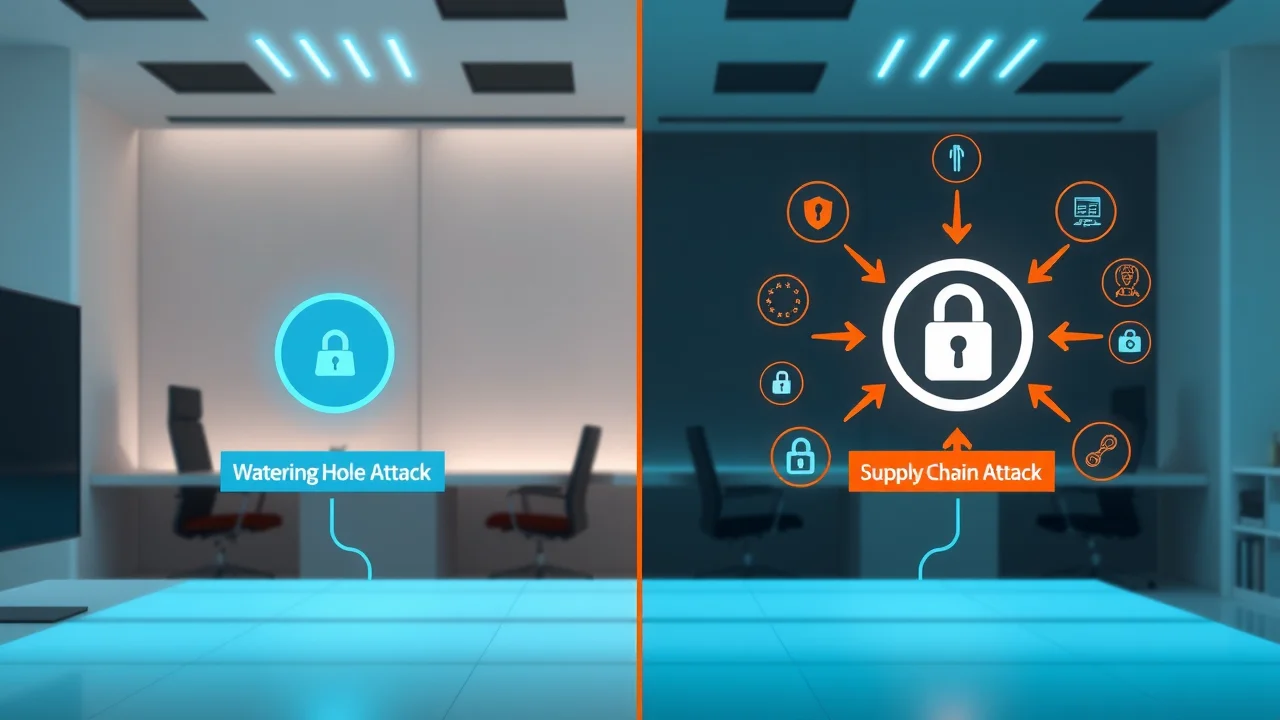
Comparing Watering Hole Attack vs. Supply Chain Attack
At first glance, watering hole attacks and supply chain attacks might appear similar—they both leverage third-party relationships to target organizations. However, there are key distinctions. In a supply chain attack, the attacker compromises software or hardware used by many organizations; think of threats embedded in widely-used updates, drivers, or cloud services. These attacks aim to infiltrate companies through the tools they rely on every day.
Conversely, a watering hole attack specifically targets frequently visited web portals rather than distributing malware through product updates or supply chain links. The attackers infect a trusted website that is part of an industry ecosystem, silently delivering malware when the target group visits. While both attacks exploit trust, the watering hole approach is uniquely browser-focused and hijacks the user’s browsing habits, while supply chain attacks abuse established update or distribution channels.
Watering Hole Attacks vs. Phishing and Other Hole Attacks
The main difference between a watering hole attack and traditional phishing is that phishing attacks cast a wide net, tricking users through malicious emails or deceptive links. While phishing relies on user error, watering hole attacks manipulate trusted web environments. In these attacks, even security-savvy users may get compromised as the malicious site is a portal or news platform they regularly visit and trust.
Other types of hole attacks, including drive-by download attacks or browser exploit kits, also exploit web browser vulnerabilities—but often without the targeted reconnaissance and precision of a true watering hole attack. Attackers compromise random or less strategically relevant websites. Watering hole attacks, by contrast, prioritize quality over quantity, infecting sites strategically chosen for their target audience or target group.
People Also Ask: Key Questions About Watering Hole Attacks
What is a watering hole attack?
A watering hole attack is a cyberattack where threat actors compromise legitimate, frequently visited websites to stealthily infect users who visit them. Instead of directly attacking individuals or organizations, hackers infect the target’s trusted online “gathering places,” utilizing malicious scripts or exploits to gain access and potentially establish remote access for further intrusions.
What is an example of a watering hole attack?
One famous example occurred in 2013, when attackers compromised several websites used by U. S. government agencies, including the Council on Foreign Relations. By leveraging zero-day vulnerabilities in Internet Explorer, they infected site visitors’ systems with stealthy malware.
Only select users—those tied to certain organizations or locations like the United States—were targeted, demonstrating the precision of watering hole attacks and how attackers compromise websites central to a target group’s workflow.

What are some common symptoms of a watering hole attack?
Common symptoms include unexpected security alerts from your antivirus software, unusual redirects to unfamiliar sites, problems with frequently visited legitimate websites, suspicious user account activity, and sudden changes in system performance. If your device starts behaving oddly after visiting a trusted website—especially if it’s tied to your business or industry—it could be a sign that you’re experiencing a watering hole attack.
What is the difference between supply chain attack and watering hole attack?
A supply chain attack targets the tools, services, or software a business depends on by compromising their updates or distribution channels, affecting a broad pool of victims through a provider’s product. In contrast, a watering hole attack targets website traffic—infecting legitimate websites likely to be visited by a specific user group and delivering malware when those individuals interact with familiar online environments.
Tactics, Techniques, and Procedures: How Watering Hole Attacks Work
Hackers behind watering hole attacks use a combination of advanced techniques. They may first gain access through weak points in ad networks serving the target site or exploit unpatched browser flaws. Many times, attackers utilize zero-day exploits—undisclosed vulnerabilities that even up-to-date antivirus software may miss. Drive-by download scripts are commonly injected into infected websites, silently installing malware when a user simply visits the page.
To evade detection, attackers often tailor the delivery based on a visitor’s browser type or operating system (such as targeting those with obsolete Internet Explorer versions). By bypassing traditional security tools and monitoring visitor behavior, they can stealthily maintain their presence on the compromised site for weeks or months, maximizing their chances of reaching prime targets within an organization.
Infecting ad networks
Using zero-day exploits
Installing drive-by download scripts
Bypassing traditional security tools

This animated scenario walks you through each stage of a watering hole attack—from site compromise to user infection—making it easy to see how quickly a trusted webpage can become a cyber trap. Watch as infographic transitions and clear narration break down this complex cyber threat.
Detecting an Active Watering Hole Attack: Warning Signs & Indicators
Catching a watering hole attack early is vital to limiting the damage. Security teams and savvy users should look for warning signs like abrupt security alerts, numerous redirects from familiar sites to suspicious pages, strange user account activities (such as unauthorized logins), or unexplained dips or spikes in system performance. Combining endpoint detection tools with high user awareness is your best first line of defense.
Equally important is monitoring for changes in the behavior of key websites you trust—since threat actors rely on these sites’ reputation, any unusual pop-ups, prompts for unexpected downloads, or requests for new permissions should be treated as red flags. Remain vigilant, and escalate concerns to your IT team the moment you detect something amiss.
Sudden security alerts
Unusual website redirects
Suspicious user account activity
System performance changes
How to Prevent Watering Hole Attacks: Best Practices and Proactive Defenses
Proactive prevention is the most effective way to protect your organization from watering hole attacks. Keep all browsers, plugins, and operating systems up to date, since attackers frequently exploit known vulnerabilities. Enabling robust endpoint security, including advanced antivirus software, can help detect both known and new threats.
Additionally, develop a culture of cybersecurity: conduct regular employee training on how to spot attack signs, encourage caution when clicking on unfamiliar links (even within trusted websites), and implement layered security defenses such as isolating critical systems from routine web browsing. By adopting these strategies, you make it far more difficult for attackers to leverage watering holes for compromise.
Keep browsers and plugins updated
Enable robust endpoint security
Avoid clicking on suspicious links
Train employees to recognize attack signs

Cybersecurity professionals outline step-by-step strategies for blocking watering hole attacks and share real-world stories that highlight why layered defenses matter more than ever.
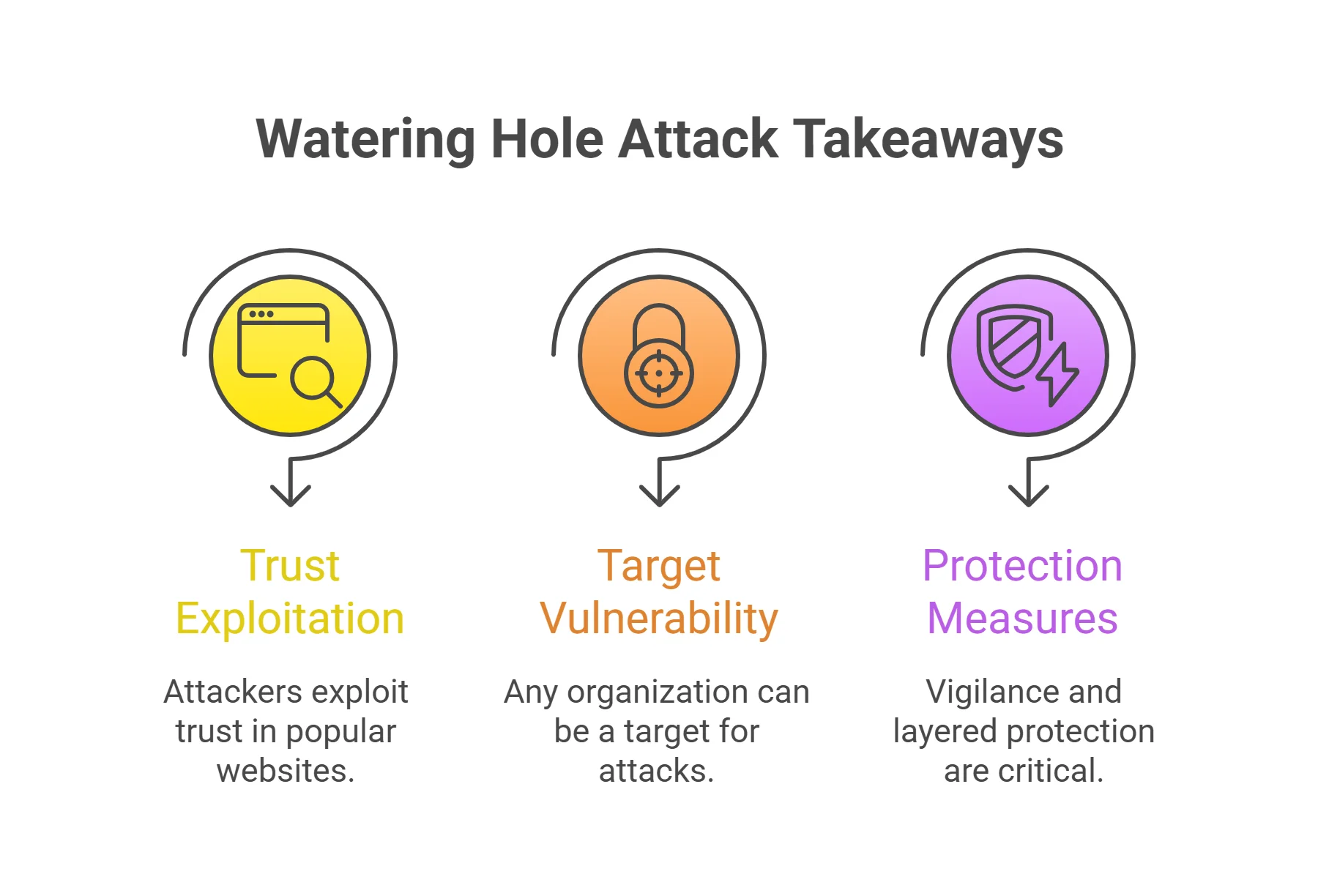
Summary: Key Takeaways on Watering Hole Attack Explained
They exploit trust in popular websites
Any organization can be a target
Vigilance and layered protection are critical
Watering Hole Attack Explained: Frequently Asked Questions (FAQs)
Q: Who is most at risk of watering hole attacks? A: Any individual or business regularly visiting industry-specific sites.
Q: Can antivirus stop watering hole attacks? A: Advanced antivirus can sometimes help, but attackers often use zero-day exploits.
Q: Are watering hole attacks becoming more common? A: Yes, as hackers seek more targeted intrusion methods.
Explore More: IT Certification Training Resources
For more great IT certification training content, visit: ITCertificationJump.com
If you’re eager to expand your cybersecurity expertise beyond watering hole attacks, consider exploring the broader landscape of digital accountability and evidence. Understanding non-repudiation is a powerful next step—it’s the principle that ensures actions in cyberspace can’t be denied, which is crucial for both incident response and legal compliance.
Dive into the essentials of non-repudiation in cybersecurity to see how organizations can strengthen trust, enforce responsibility, and build more resilient defenses against sophisticated threats.
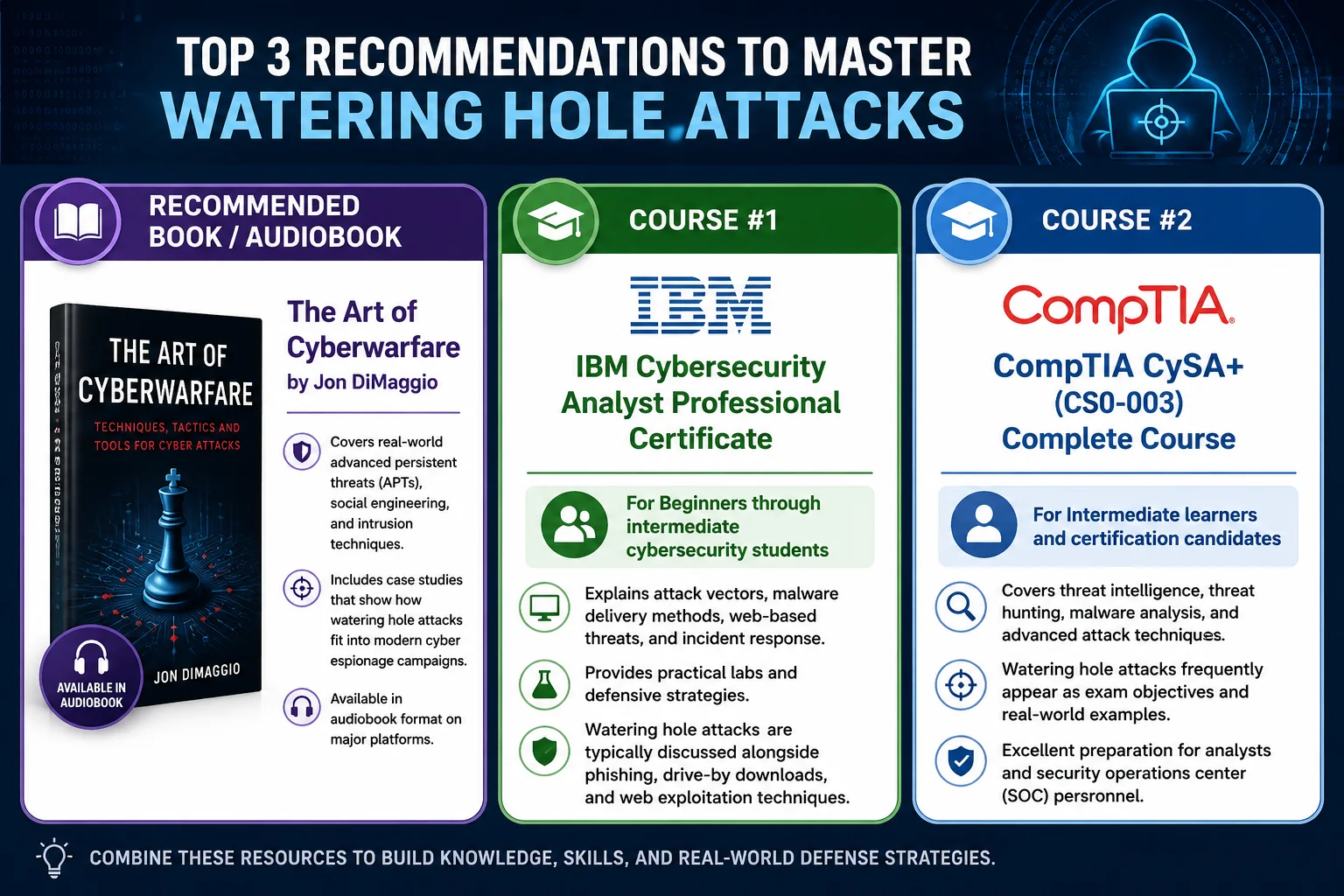
Want to learn how hackers compromise trusted websites to infect specific targets?
Start with The Art of Cyberwarfare to understand the attacker mindset, then take the IBM Cybersecurity Analyst and CySA+ training programs to learn how security professionals detect and stop watering hole attacks before they spread.
📘 Recommended Book / Audiobook:
The Art of Cyberwarfare by Jon DiMaggio
For Beginners through intermediate cybersecurity students:
IBM Cybersecurity Analyst Professional Certificate
For Intermediate learners and certification candidates:
CompTIA CySA+ (CS0-003) Complete Course
Article Sources
CISA – https://www.cisa.gov/news-events/news/understanding-watering-hole-attacks
Norton – https://us.norton.com/blog/emerging-threats/what-is-a-watering-hole-attack
Crowdstrike – https://www.crowdstrike.com/cybersecurity-101/watering-hole-attack/
Imperva – https://www.imperva.com/learn/application-security/watering-hole-attack/
To deepen your understanding of watering hole attacks, consider exploring the following authoritative resources: “Watering hole attack” on Wikipedia provides a comprehensive overview of the attack strategy, including its definition, notable examples, and defense techniques. (en. wikipedia. org)
“What is a Watering Hole Attack?” by TechTarget offers an in-depth explanation of how these attacks work, their effectiveness, and signs to watch for. (techtarget. com)
These resources will equip you with a thorough understanding of watering hole attacks, their mechanisms, and strategies for prevention. ITCertificationJump.com



Write A Comment